
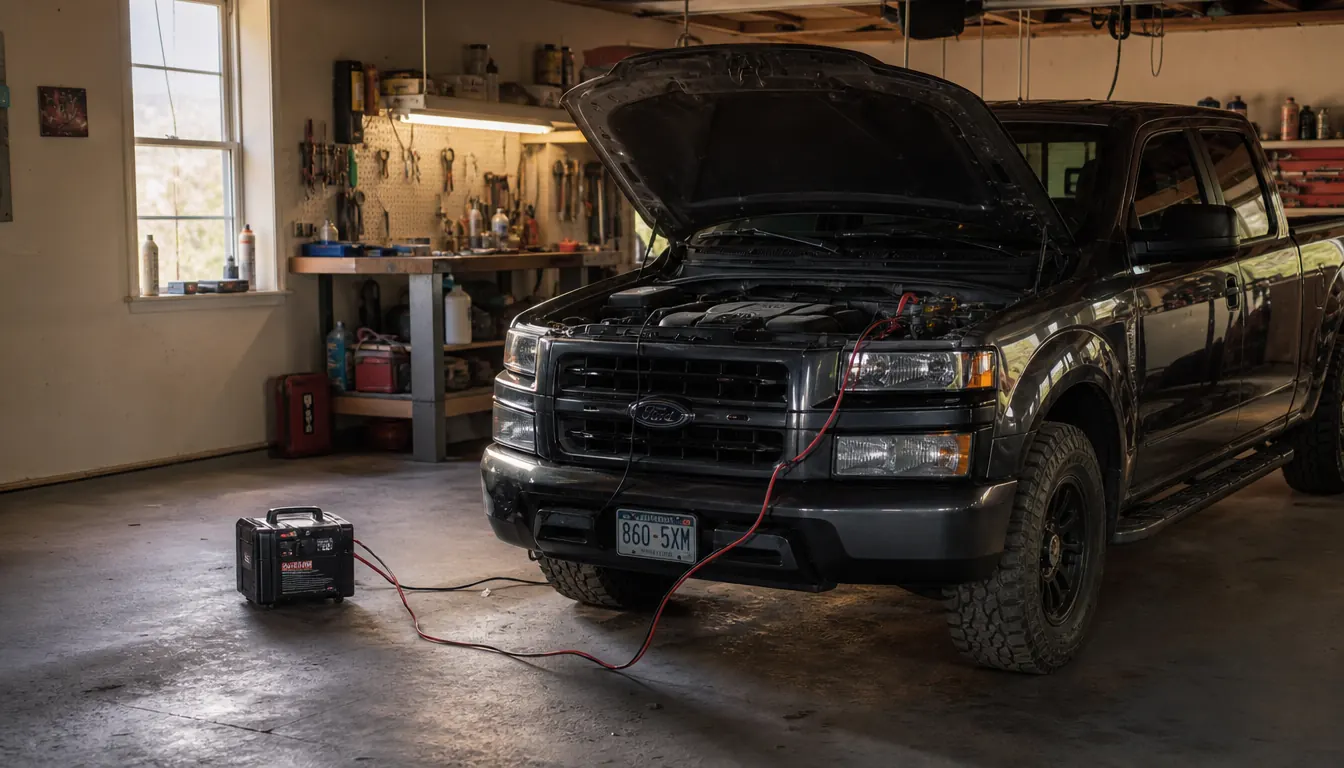
If you park a truck for more than a few days, you have probably seen the argument play out in the comments section: buy a Battery Tender, or just grab a cheap trickle charger and call it done. I have used both over thirty years of turning wrenches, and the honest answer is that they are not the same tool. The difference is not in the cord or the clamps. It is in what the charger does when the battery is full.
A basic trickle charger pushes a fixed current into the battery until you unplug it. A Battery Tender Plus measures the battery, charges it, and then drops to a float voltage that holds it without cooking it. That one difference decides whether you come back to a battery that starts the truck or a battery that needs replacing.
| Battery Tender Plus | Basic Trickle Charger | |
|---|---|---|
| Charging behavior | Three-stage: bulk charge, absorption, then float | Fixed current until you unplug it |
| When the battery is full | Drops to 13.2V float and holds it | Keeps pushing current, which can overcharge |
| Safe to leave connected | Yes, for months at a time | Risky past a day or two |
| Best for | A stored truck, ATV, or classic car | A nearly dead battery you can watch |
| Price | Costs more up front | Cheaper at the register |
| Monitoring | Status lights show charge and float mode | Usually just a power light |
Where the Battery Tender Plus Wins
The Battery Tender Plus wins the only test that matters for a stored vehicle: it keeps the battery healthy without supervision. The three-stage charging profile is the whole story. It starts with a bulk charge at 1.25 amps, moves to absorption as the battery fills, and then drops to a float voltage around 13.2 volts. At that point it is not really charging anymore. It is just holding the battery where it wants to be. I have left mine connected to my 2014 F-150 for six weeks at a stretch, and the truck fires up like it was driven yesterday.
The status lights are worth mentioning too. The Battery Tender Plus has a red light that stays on while it is charging and a green light that comes on when it switches to float. That is not a gimmick. It tells you the charger is actually doing its job, and it tells you when the battery has reached full charge. A basic trickle charger gives you a power light and nothing else. You are left guessing whether the battery is at 60 percent or 100 percent, and guessing is how batteries get overcharged.
Last winter I put my 2014 F-150 away the second week of December. The garage is unheated, and most nights the temperature dropped into the twenties. I clipped on the Battery Tender Plus, ran the cord under the door, and did not think about it again until the third week of January. When I opened the door, the dome light came on bright, and the starter turned the engine over like it was August. That is the outcome the float stage is built for. A charger that keeps pushing full current would have spent those six weeks fighting the battery instead of holding it.
I have also used it on a battery that was not completely dead but was sitting at 11.8 volts after a month of cold storage. The Battery Tender Plus brought it back to a full charge overnight, then settled into float mode by morning. The green light was on when I went out to the garage, and the battery held 12.6 volts a week later with the charger disconnected. That is the difference between maintaining a battery and just pushing current into it until something gives.
I will say one more thing about the float stage, because it is the part people misunderstand. When the green light comes on, the Battery Tender Plus is not still charging at full current. It is holding the battery at a steady voltage and letting the charge taper off naturally. That is why you can leave it connected for months. The battery sits at full charge without being hammered. With a basic trickle charger, there is no taper. The current stays the same whether the battery is at 20 percent or 95 percent, and that is exactly how a battery gets overcharged.
Summer is actually a worse test than winter in some ways. Heat speeds up the chemical reaction inside a battery, which means more self-discharge and more water loss. I have seen batteries fail in July that were fine all winter. The float stage matters just as much in the heat. The Battery Tender Plus holds the voltage steady and does not let the battery cook, and that is worth keeping in mind if you store a vehicle in a hot garage. The same logic applies in both seasons: a battery left alone slowly loses charge, and a charger that does not know when to stop makes the problem worse.

Where a Basic Trickle Charger Wins
I am not going to tell you the cheap trickle charger is useless, because it is not. It wins on price, plain and simple. If you have a battery that is completely dead and you are standing there waiting to bring it back, a basic trickle charger will push current into it and get it done. For that one job, the extra cost of the Battery Tender Plus buys you nothing. A trickle charger is also fine if you are the type who plugs it in, watches it, and unplugs it the same day. The danger is never the charger itself. It is leaving it connected.
There is one more place the basic charger wins, and it is a small one: it is simpler. No modes, no lights to interpret, no learning curve. You clip it on, plug it in, and it pushes current. For a guy who just wants to boost a battery back to life in an afternoon, that simplicity is a feature. The problem is that the same simplicity becomes a liability the moment you walk away and forget about it.
I can give you a concrete example from a few winters back. I pulled the F-150 out of storage, turned the key, and got nothing but a click. The battery measured 8.4 volts, which is too low for any smart charger to even recognize. I hooked up an old basic trickle charger, checked it every hour, and by late afternoon the voltage was back up around 12.4. I unplugged it before supper and put the Battery Tender Plus on overnight to finish the job. The trickle charger did exactly what I asked of it. The problem is that I had to stand there and watch it. Leave that same charger on for three days and the battery would have been the casualty.
The reason comes down to how a fixed-current charger works. It does not measure the battery's state of charge. It just keeps pushing its rated current, and as the battery fills, the voltage climbs higher and higher. Leave it connected long enough and you drive the battery into gassing, where the electrolyte boils off and the plates start to warp. A Battery Tender Plus avoids that by cutting back to a float voltage once the battery is full. The basic charger cannot do that, because it does not know what full looks like.
Another honest point in favor of the basic charger is that it is everywhere. You can find one at any auto parts store, any hardware store, and probably the checkout aisle of a farm supply place. If you need a charger today, you do not have to order anything or wait for shipping. The Battery Tender Plus is also easy to find, but the basic charger is the default option on every shelf. That availability matters when you are in a hurry and the battery is already dead.
Let me also be fair about the price gap. The basic charger is cheaper at the register, sometimes by a wide margin, and if you only need it once or twice a year, that margin is real money. I am not going to tell you the Battery Tender Plus pays for itself in every situation, because it does not. It pays for itself when it saves you from replacing a battery, and that only happens if you are the kind of person who leaves a charger connected for weeks. If you are not that person, the basic charger is the honest buy.
Keep your truck ready to start, even after a month in the garage
The Battery Tender Plus charges, then holds, so you never have to remember to unplug it. That is the whole difference.
Amazon Check Today's Price on Amazon →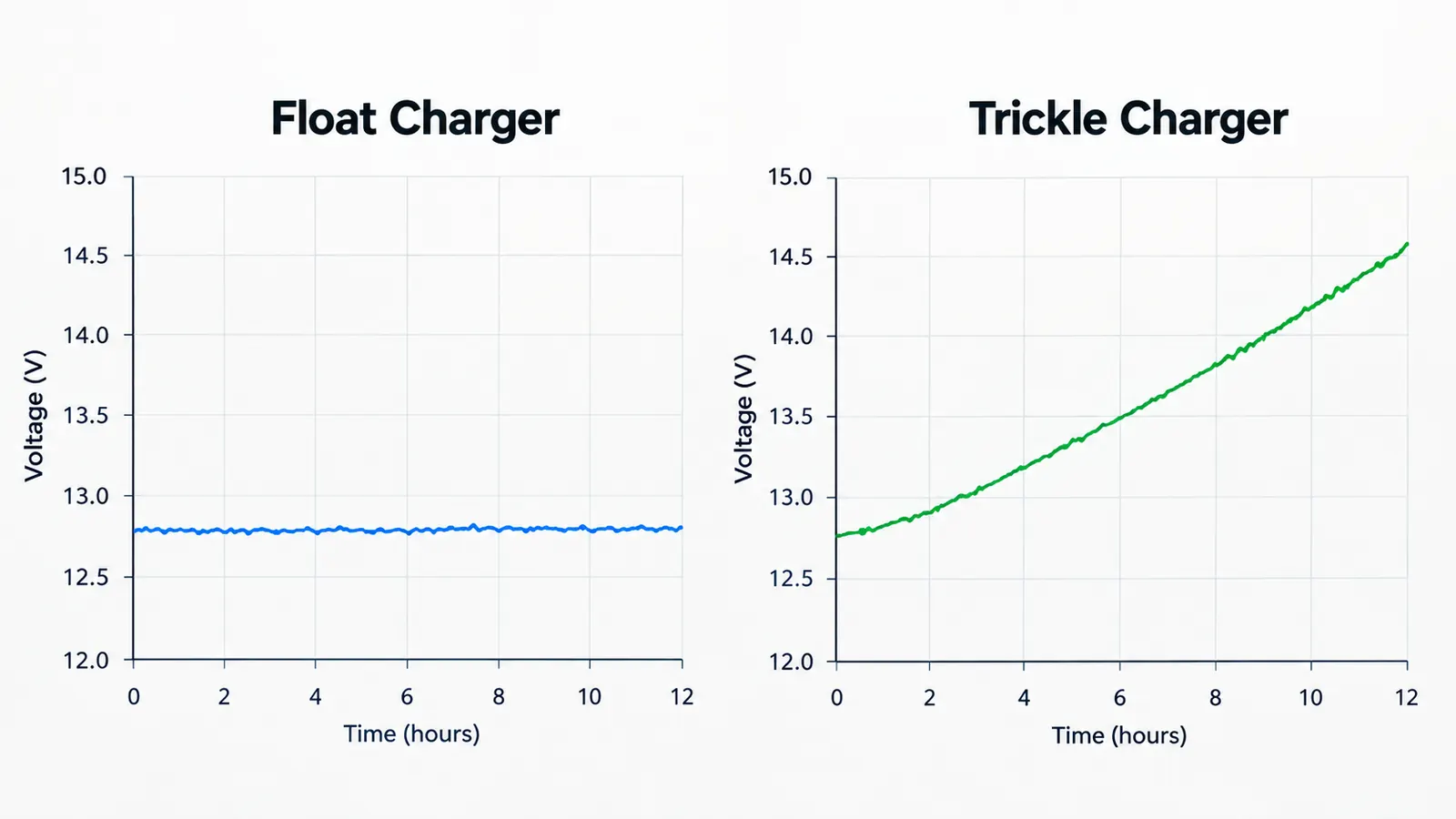
Who Should Buy Which
Buy the Battery Tender Plus if you store a truck, a classic car, an ATV, or a motorcycle for weeks at a time. Buy it if you want to plug something in and forget about it until spring. Buy it if you have killed a battery before by leaving a charger on it, because this is the tool that fixes that specific mistake. The 1.25 amp output is small, and that is deliberate. Small is what makes it safe to leave connected.
Buy a basic trickle charger if you only need to revive a dead battery once or twice a year and you will be standing there while it charges. Buy it if you are on a tight budget and you understand the limitation. Just do not buy it expecting to leave it connected to a stored truck. That is the one job it does not do, and it will cost you a battery to learn that lesson.
Let me be more specific about my own garage. My F-150 is a 2014 model, and it is the only vehicle I keep. It sits for weeks at a time in the winter, and the garage is unheated, so the battery takes a beating from cold soak and parasitic draw from the truck's computer. For that situation, the Battery Tender Plus is the right tool. I connect it, run the cord under the garage door, and forget it. If I only needed to bring a dead battery back once a year, I would not spend the extra money. The question is not which charger is better in a fight. It is which one matches how you actually use it.
One thing I would add: do not use either one on a battery that is frozen. A frozen battery can crack or leak when you put current into it. If the electrolyte is frozen, let the battery warm up to above freezing first, then charge it. That is true for the Battery Tender Plus and for the cheapest trickle charger. The Battery Tender Plus is safer in almost every way, but it is not a magic box that changes the chemistry of a frozen battery.
If you are trying to decide today, here is the short version. If the truck sits for more than two weeks at a time, buy the Battery Tender Plus and do not look back. If the battery is already dead and you need it running by tonight, a basic trickle charger will get you there as long as you watch it. The mistake is buying the basic charger for the first job, because that is the job it cannot do.
One last thing worth saying: do not overthink the brand name. There are other maintainers on the market, and some of them work fine. I stick with the Battery Tender Plus because it has never given me a reason to switch, and because the float voltage is consistent every time I check it with a multimeter. But the important part is the behavior, not the logo. A charger that drops to float when the battery is full is the tool you want. A charger that keeps pushing current is the tool you have to babysit.
Set it and forget it, the way a stored battery should be
The Battery Tender Plus is the charger you can leave connected all winter. That is the whole point.
Amazon Check Today's Price on Amazon →