
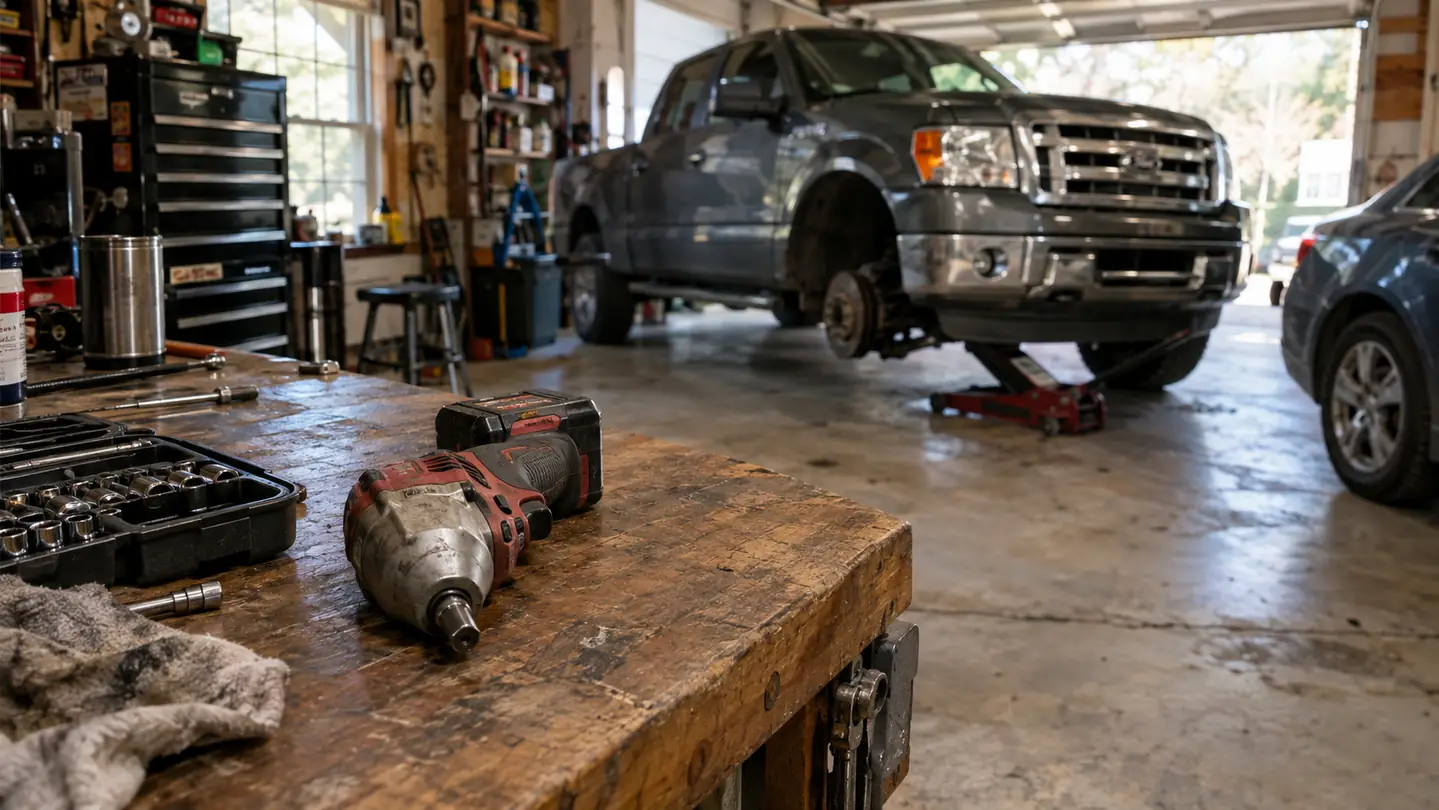
I spent thirty years turning wrenches on heavy equipment, so I've broken enough rusted bolts to know the value of a good impact wrench. Since I retired, most of my wrench work happens in my own two-car garage on my 2014 F-150. The first time I had to crack a torqued-to-spec lug nut loose with a breaker bar and a length of pipe, I told my wife Diane that my hands just don't enjoy that trick twice a week anymore. That's why I ended up with both the DEWALT DCF900 and the Milwaukee M18 Fuel half-inch impact wrenches on the same workbench, and why I spent a few months using them on the same jobs and keeping honest notes on what each one actually did.
Short answer before anything else: for a home garage, I'd take the DEWALT, and not because it's the stronger wrench. It isn't. The Milwaukee beats it on torque and on a couple of controls I genuinely like. But the DEWALT costs less, spins fast enough for anything a weekend garage actually throws at it, and if your shop already runs on the 20V MAX battery family, the same batteries and chargers drop right in. When two tools finish the same job and the only real difference is headroom you will never use, I'd rather spend the difference on a spare battery.
| DEWALT DCF900 | Milwaukee M18 Fuel | |
|---|---|---|
| Breakaway torque | up to 1,200 ft-lbs, enough for most rusted hardware | up to 1,400 ft-lbs, a real step up on seized bolts |
| Fastening torque | up to 700 ft-lbs for lug nuts and suspension work | up to 1,000 ft-lbs if you ever drive bigger anchors |
| Drive controls | three speeds and a variable trigger, simple to learn | four modes including bolt removal that backs off after the fastener breaks |
| Socket fit | standard half-inch drive, anvil holds the socket in place | standard half-inch drive, anvil holds the socket in place |
| Typical price | sells for less on most days | premium price for the extra torque |
| Warranty | three year limited warranty | three year limited warranty |
| Best fit | home garages and trucks that see weekend work | shops doing heavy suspension and fleet work |
How I Tested Them
Both wrenches came out of the box charged and got worked over the same way: lug nuts on the F-150 that I'd torqued to spec and left alone for a month, a lower control arm bolt with sixty thousand miles of crud on it, and a pile of grade eight hardware cinched to known settings with a torque wrench so I could watch how each tool behaved at the edges.
I tested them the way a guy actually uses a tool, not the way a spec sheet describes one. That means letting the socket seat, pulling the trigger, and listening for the rattle that tells you the fastener just broke. I started with the lug nuts because that's the job most of you will buy one of these for. Both wrenches zipped them off without drama. The Milwaukee felt like it had more in reserve, and the DEWALT got the same nuts off in the same amount of time, because the limiting factor was me, not the tool.
The control arm bolt was where the two tools separated. That bolt had been in place since the truck left the assembly line, and it did not want to come out. The Milwaukee cracked it in one sustained pull, and then its bolt removal mode backed the fastener off and stopped before the bolt went tumbling across the garage floor. The DEWALT broke it loose too, just with a little more patience. I'll get to the rest of that story in a minute. The short version is that both tools got the job done, and neither one ever sent me reaching for the pipe.
One thing worth saying before the details: both of these are heavy tools, and both will strain your wrist if you use them one-handed all afternoon. I did every test with two hands and the wrench braced, the way the manual tells you to, and I'd tell anyone working out of a home garage to do the same. This class of impact wrench exists to break rusted fasteners, not to feel delicate in your hand. If you want dainty, buy a smaller driver. You won't find dainty here.
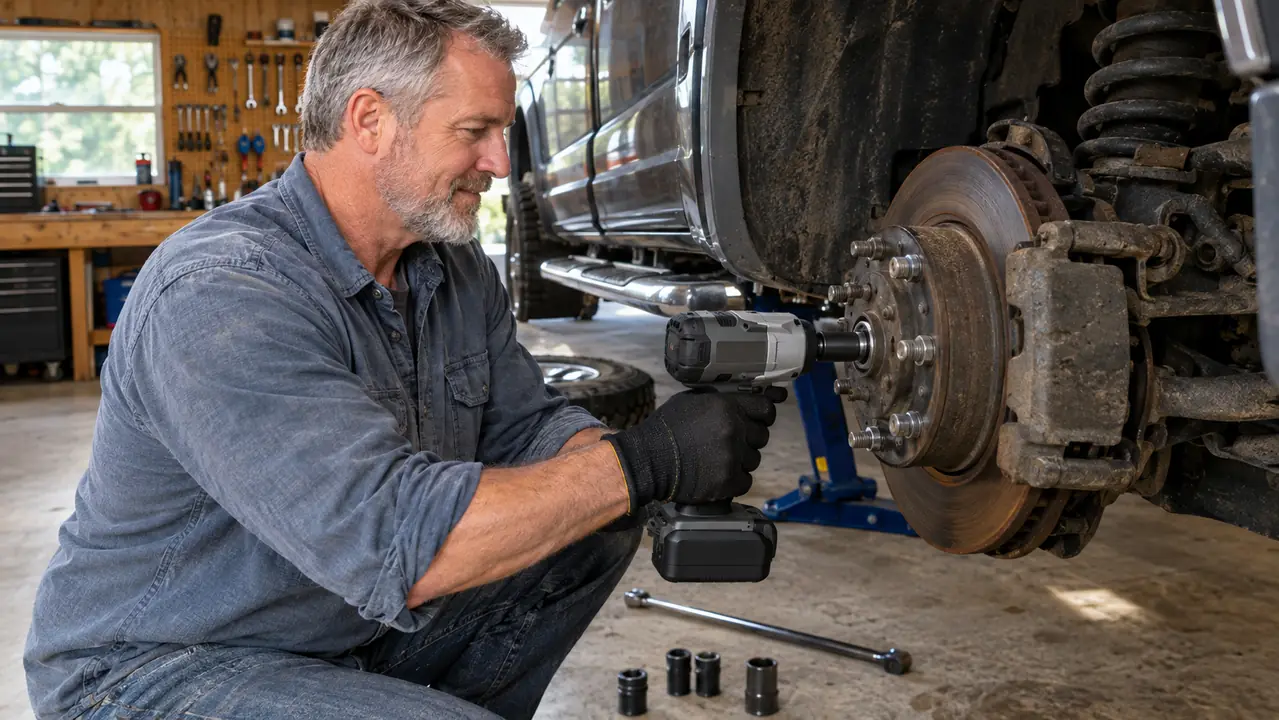
Where DEWALT Wins
The first place the DEWALT wins is on the wallet, and I don't think that's a small point for a home garage. The Milwaukee is the stronger tool, full stop, and it costs like it. The DEWALT gives you most of the real-world performance at a price that leaves room for a second battery or a decent socket set. When I priced out my own kit, the money I saved on the wrench paid for the spare battery that makes the setup useful in the first place.
The DEWALT also wins on simplicity. It has three speeds and a variable trigger, and that's it. You pull the trigger, it spins, you let off, it stops. There's no mode you can bump by accident and no behavior that changes depending on which setting you left it in. For a tool that spends most of its life sitting in a drawer between tire rotations, that's a feature, not a compromise. My wife Diane picked it up one afternoon, and she had the hang of it in about ten seconds.
One more quiet advantage: the light. Both wrenches have an LED near the anvil, and the DEWALT throws a clean beam that shows you the bolt inside a dark wheel well. My garage is unheated in winter, so I do a fair amount of work in the gray hours, and being able to see the fastener without holding a flashlight in my teeth is worth more than the spec sheet would suggest.
Where Milwaukee Wins
I'm not going to pretend the Milwaukee's extra torque doesn't matter, because for some people it does. Fourteen hundred foot-pounds of breakaway torque is serious muscle. If you do suspension work on older trucks, if you live where the roads get salted and every bolt is a gamble, or if you find yourself working on equipment that hasn't moved in years, that headroom is the difference between a five minute job and a two hour one. The DEWALT will get there eventually. The Milwaukee just doesn't make you wait as long.
The controls are where the Milwaukee genuinely earns its keep. The bolt removal mode is not a gimmick. It hits the fastener hard to crack it loose, then backs off the speed and stops once it's free, so you don't launch a lug nut into the weeds or spin a bolt out across the garage. After a month of using both wrenches, that mode was the single feature I kept wishing the DEWALT had. It's the kind of thing you don't know you want until you've used it on a truck you actually drive.
If your shop already runs on M18 batteries, this is the easier conversation. The Milwaukee stands on its own merits, and when the chargers and batteries are already on your wall, the case for it gets stronger than any torque number. Tool systems are sticky for a reason. You buy into one battery family and you stay there.
Want the wrench that covers a home garage without breaking the bank?
The DEWALT DCF900 handles lug nuts, suspension bolts, and the odd seized fastener with the same battery family most garages already run. Check today's price on Amazon and see what a half-inch impact wrench does to your weekend list.
Amazon Check Today's Price on Amazon →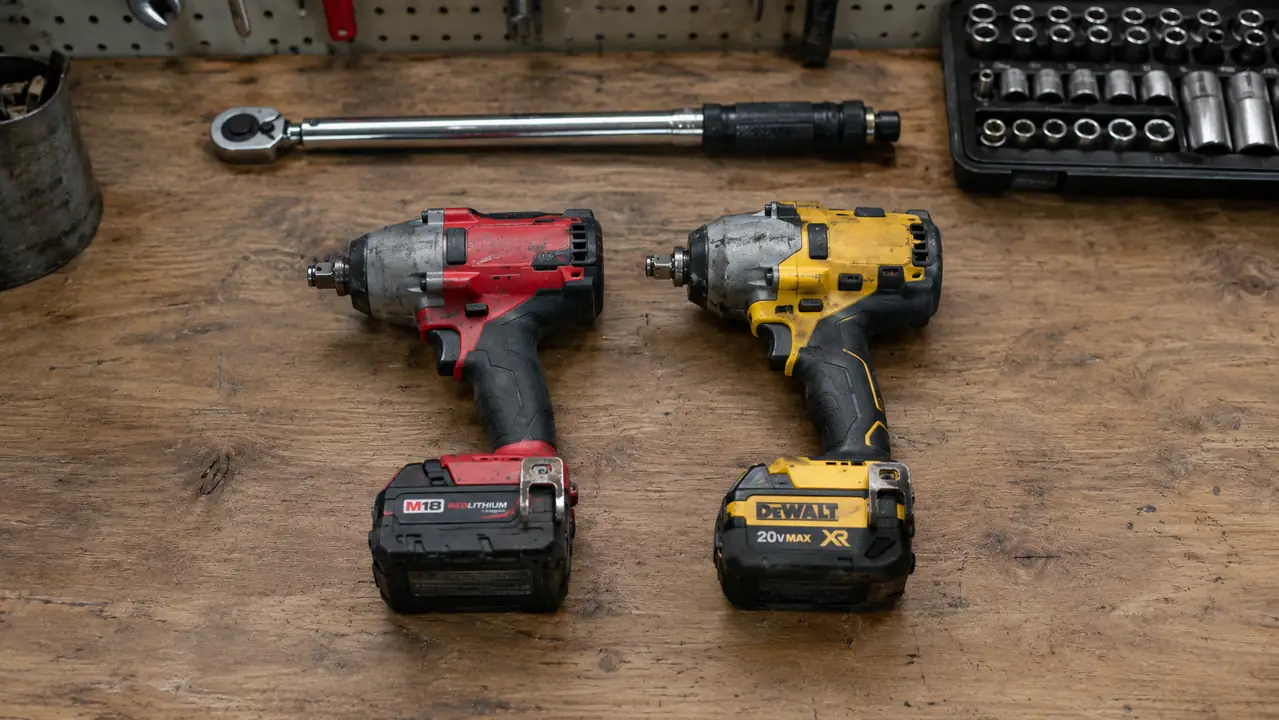
The One Thing That Surprised Me
I expected the Milwaukee to feel like the bigger tool in every way, and it doesn't. The DEWALT is better balanced, and after a day of use I kept reaching for it first even though I knew it was the weaker of the two on paper. That surprised me. I bought both of these planning to keep the Milwaukee and sell the other one. In the end, I kept the DEWALT.
Part of it is the trigger. The DEWALT's variable speed control is predictable in a way that matters when you're working on the truck you plan to drive to work on Monday. The Milwaukee does what you ask of it, but it asks you to be a little more deliberate about the mode you're in. For a guy who spent thirty years with his hands on wrenches, I'd rather have a tool that does the simple things perfectly than one that needs me to manage it through a tricky job.
I also kept an eye on battery life, because a dead tool in the middle of a job is worse than no tool. Both wrenches ran through a full charge without complaint on the work I threw at them, and neither ever quit mid-fastener. I won't pretend I ran a scientific endurance test, because I didn't. I just noticed I charged both batteries less often than I expected, and that's about the best you can ask for.
The Milwaukee is the stronger wrench. The DEWALT is the one I reach for on a Saturday morning.
Who Should Buy Which
Buy the DEWALT if you're the person this article is really for: a home garage, one truck or car, weekend work, and a budget that has to cover more than just the wrench. It costs less, it shares batteries with the 20V tools a lot of you already own, it's simpler to pick up and use, and it will break loose every lug nut on your vehicle without complaint. Unless you're doing suspension work every week, the extra torque on the Milwaukee is headroom you pay for and rarely touch.
Buy the Milwaukee if you already own M18 tools, if you work on older or rust-belt vehicles where every fastener is a gamble, or if you do enough heavy work that the bolt removal mode pays for itself in saved knuckles and lost lug nuts. There's no shame in buying the stronger tool. My complaint was never that the Milwaukee isn't worth its price. It is. It just costs more than most home garages need to spend.
One last practical note for truck owners. Half-inch drive sockets for these wrenches are the same ones you already own, so you're not buying into a new socket system, and both tools have enough grunt to spin lugs off without you leaning your whole weight on the handle. On the F-150 I used a swivel socket on a couple of stubborn spots near the brake line, and both wrenches fit into the wheel well without a fight. The extra torque of the Milwaukee never once saved me from a spot the DEWALT could not reach.
Me, I kept the DEWALT in the garage for the F-150 and loaned the Milwaukee to my brother-in-law, who restores old pickups and can put the extra muscle to work. If you ask me which one I'd buy with my own money knowing what I know now, it's the DEWALT. If you ask me which one I'd want if I were still turning wrenches on heavy equipment for a living, it's the Milwaukee. They're both good tools. They're built for different jobs, and most of you are doing the job the DEWALT was made for.
Your truck's lug nuts aren't going to loosen themselves.
The DEWALT DCF900 is the half-inch impact wrench I keep in my own garage for the F-150. Check today's price on Amazon before you reach for the breaker bar one more time.
Amazon Check Today's Price on Amazon →