
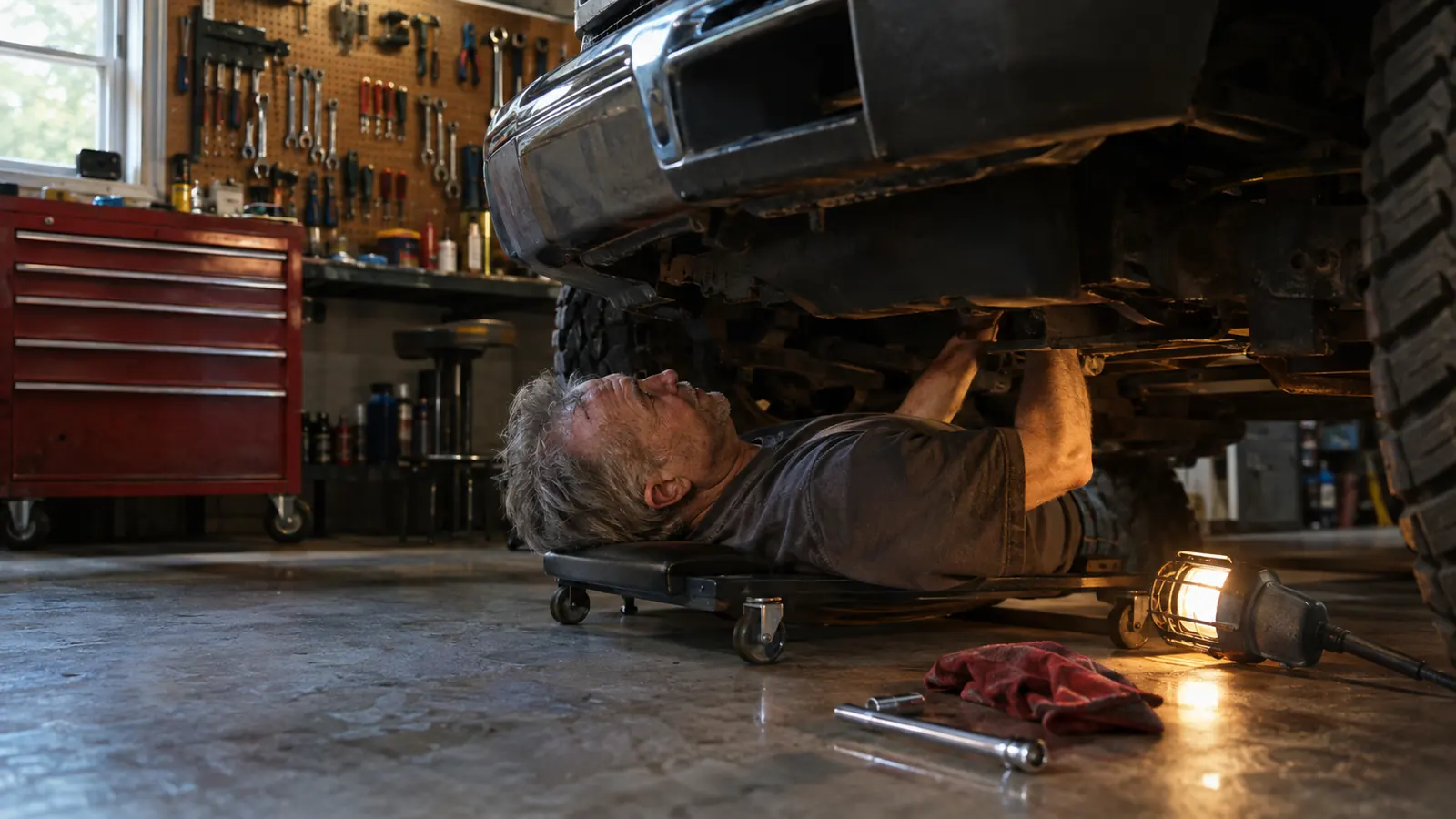
The first time I rolled under my 2014 F-150 on the Pro-LifT creeper, I was 57 years old, flat on my back, and wondering why I had spent the last 30 years doing this the hard way. Thirty years turning wrenches professionally taught me to be suspicious of anything that promises to make the job easier. Most of it is gimmicks. But after six months of oil changes, brake jobs and underbody work in my own garage, the Pro-LifT creeper has earned a permanent spot next to my rolling tool chest.
This is not a review written after one afternoon of rolling around and feeling the padding. This is a review written after the creeper sat in an unheated garage through a Pennsylvania winter, carried the weight of a 220-pound man hundreds of times, and took its share of drops and kicks. I have used it enough to know exactly what it does well and exactly where I would change it.
The Quick Verdict
The Pro-LifT creeper is the rare garage tool that does exactly what it promises: it gets you low, keeps you comfortable, and holds up to real use. Not perfect, but the best creeper I have owned in 30 years.
Amazon Check Today's Price →Stop rolling around on a cold concrete floor
The Pro-LifT creeper is the tool I reach for before every oil change now. Check today's price on Amazon and see why it earned a permanent spot in my garage.
Amazon Check Today's Price on Amazon →How I've Used It
My garage is a detached two-car with one bay for projects and one bay for the truck. The floor is bare concrete, unheated in winter apart from a portable heater I aim at the front of the truck while I work. On a January morning that concrete reads about 40 degrees even with the heater running, and you feel it through everything. Before the Pro-LifT, I did oil changes on a piece of cardboard and regretted it every time. The cold worked its way through in about ten minutes, and my back complained for the rest of the day.
Over the last six months I have used the Pro-LifT for four oil changes, two brake jobs, a tire rotation, and a handful of smaller jobs like chasing a rattling heat shield. The oil changes came in October, December, February and April, so the creeper has seen the floor at its coldest and at its warmest. The brake job in March was the real test: I was under the truck for close to two hours doing front pads and rotors, and the only thing that got sore was my hands. That is the kind of steady, unglamorous use that separates a good tool from a gimmick. The tire rotation in January took less than an hour, and most of that was jacking the truck up. The creeper made the time under the truck pass quickly, and I finished before the heater had the garage warm.
The truck is a 2014 F-150, which sits high enough that I do not need jack stands to slide underneath for an oil change, but low enough that I still want something between me and the concrete. The Pro-LifT gives me about four inches of padding and a set of wheels that move the way I expect them to. That sounds like a small thing until you have spent twenty minutes trying to shove a cheap creeper sideways with your elbows.
One Saturday in February I had the truck up on jack stands to replace the rear differential fluid. That is a job where you are not moving much, just lying there with a pump and a catch pan, and it takes patience. I was under there for the better part of an hour and a half. On the old cardboard setup I would have been up and down four times trying to get comfortable. On the Pro-LifT I stayed put the whole time and finished without a single pause to stretch my back. That was the moment I stopped thinking of the creeper as a nice-to-have and started thinking of it as part of the routine.
What the Pro-LifT Creeper Gets Right
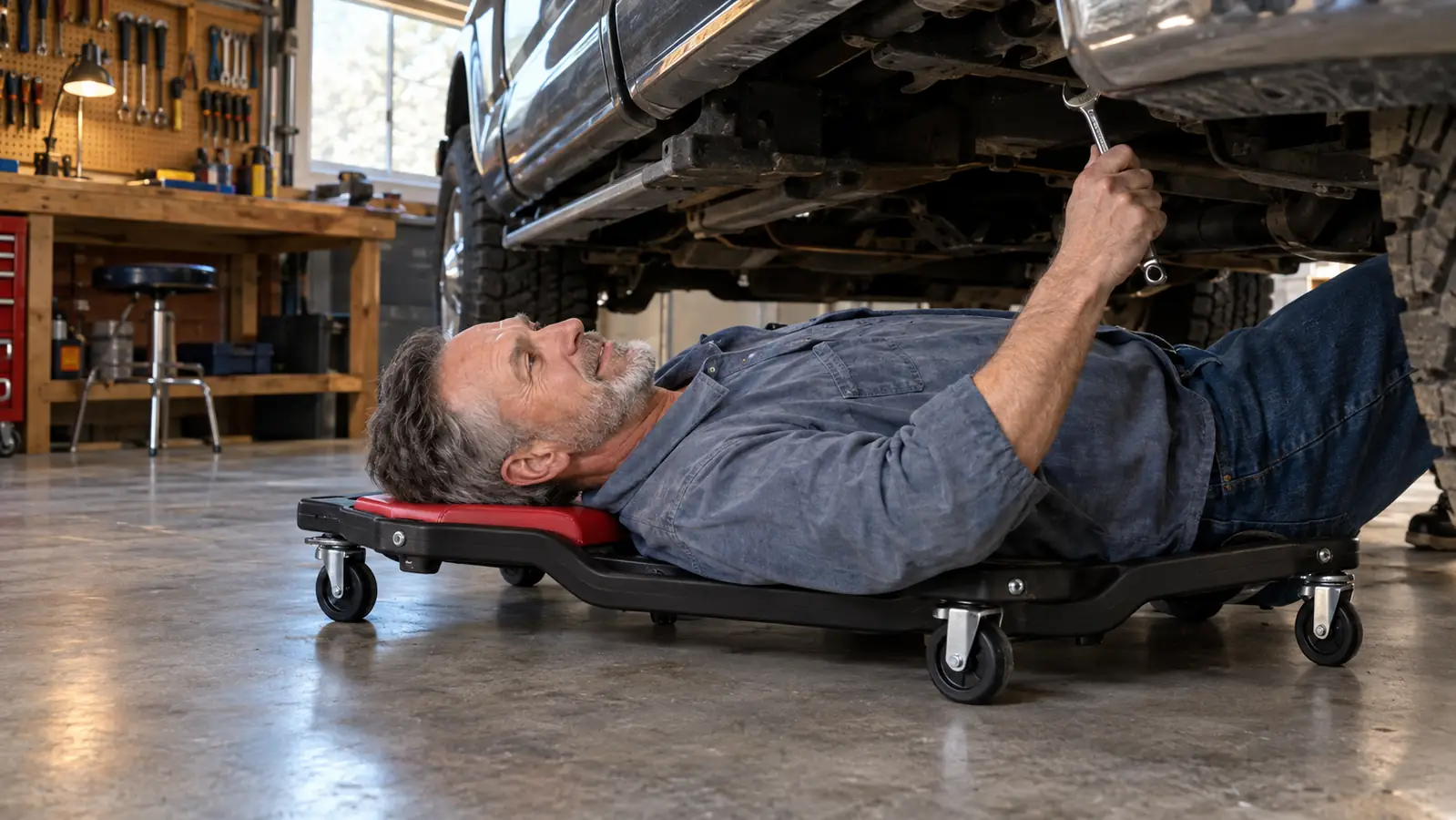
The first thing you notice is the padding. The Pro-LifT uses a thick foam pad that actually stays put. I have used creepers where the pad slides around the moment you shift your weight, and creepers where the padding is so thin you might as well be on the floor. This one is thick enough that my hips and shoulders are comfortable for a full oil change, and the pad has not moved a millimeter in six months. I have also used it on a few jobs where I expected the padding to compress and it did not. My hips are the first thing to complain on a hard surface, and they have not complained once on this pad.
The second thing is the wheels. The Pro-LifT has six wheels, which sounds like overkill until you are under a truck trying to move six inches to the left. The extra wheels make it stable and easy to steer with your feet. I can roll from the oil drain plug to the filter without getting up, and I can push myself back out from under the truck without reaching for the frame. That is the kind of detail you only appreciate after using a creeper with four cheap wheels that catch on every crack in the concrete.
The third thing is the headrest. It sounds like a small feature, but when you are lying on your back for forty minutes, the difference between a flat board and a padded headrest is the difference between getting up feeling fine and getting up with a stiff neck. The Pro-LifT headrest is angled just right, and it is one of the reasons I can do a full brake job and still walk upright afterward.
There is also the width. The platform is wide enough that my shoulders do not hang off the edges the way they did on the narrow steel creepers from the shop. I am a big guy, 220 pounds with broad shoulders, and on most creepers my arms end up dragging on the concrete when I reach for a tool. On the Pro-LifT I stay on the pad. When you are reaching up to loosen a rusted bleeder screw, having both elbows on the pad instead of the floor keeps your strength in your hands where it belongs.
Where It Falls Short
No tool is perfect, and the Pro-LifT has two weaknesses worth knowing about. The first is the tool tray. It is molded into the creeper and it works fine for holding a wrench or a socket, but it is not deep enough to hold a ratchet and a handful of sockets without them sliding off when you roll. I have learned to keep my tools in my pocket or on a small magnetic tray next to me instead of relying on the built-in tray.
The second weakness is the wheels on rough surfaces. On smooth concrete, the Pro-LifT rolls beautifully. On a garage floor with oil stains, cracks, or a little gravel tracked in from the driveway, the wheels catch and you have to give yourself a good shove to get moving. It is not a dealbreaker, and it is true of every creeper I have used, but it is worth knowing if your garage floor is not perfectly smooth.
There is one more thing I would mention, and it is minor. The creeper does not have a spot to rest your forearms when you are working above your head, so on long jobs your arms get tired faster than they would on a bench. I solved that by sliding a small rubber pad under my elbows, but it would be a nice addition in the next version. None of these are reasons to skip the creeper. They are just the honest tradeoffs you should know about before you buy.
How It Compares to the Cheap Creepers I Used for Years
For most of my career, I used whatever creeper the shop had, which usually meant a steel frame with a thin vinyl pad and four wheels that locked up if you looked at them wrong. Those creepers worked, in the sense that they got you under the car, but they were never comfortable and they never lasted. The padding wore through, the wheels seized, and the frame bent after a few years of hard use.
The Pro-LifT is a different class of tool. The frame is solid, the padding is thick, and the wheels are smooth. It is also heavier than the cheap creepers, which is a tradeoff. It weighs enough that I do not carry it around the garage; I keep it in the project bay and roll it where I need it. For a home garage, that is the right tradeoff. I would rather have a creeper that stays put and rolls well than one I can carry with one finger and that falls apart in a year.
The other difference is how it sits over time. The cheap creepers I used developed flat spots in the padding after a few months, and the vinyl cracked in the cold. After a Pennsylvania winter, the Pro-LifT padding looks the same as the day it arrived. The frame has a few scuffs from being kicked aside, and the wheels still spin freely. I checked the hardware once, in April, and nothing had worked loose. For a tool that lives on a cold concrete floor, that durability is the whole point.
What I Liked
- Thick foam padding stays put and keeps hips and shoulders comfortable through two-hour jobs
- Six wheels roll smoothly on clean concrete and steer easily with your feet
- Padded, angled headrest prevents the stiff neck you get on flat creepers
- Wide platform keeps your shoulders and elbows on the pad instead of the floor
- Frame has held up to six months of hard use in an unheated garage
Where It Falls Short
- Molded tool tray is too shallow to hold a ratchet and sockets while you roll
- Wheels catch on cracked floors or gravel tracked in from the driveway
- Heavier than cheap shop creepers, so it is not a tool you carry around
After six months and four oil changes, the Pro-LifT creeper is the first creeper I have owned that I do not think about while I am using it. That is the highest compliment I can give a garage tool.
Who This Is For
The Pro-LifT creeper is for anyone who works on their own vehicle and is tired of doing it on a cold, hard floor. If you change your own oil, do your own brakes, or spend any time under your truck or car, this creeper will make the job noticeably more comfortable. It is especially worth it if you are over 40, because the difference between a padded creeper and a bare concrete floor gets bigger every year.
It is also for anyone who has a garage floor that is not perfectly smooth. The six wheels handle minor imperfections better than a four-wheel creeper, and the extra stability means you are not wobbling every time you reach for a tool. If you have a smooth, clean garage floor, the Pro-LifT will feel even better. Mine has a few years of oil stains and one crack running from the workbench toward the door, and the six wheels roll over all of it without drama.
And it is for the person who does a little bit of everything, not just oil changes. Since I bought the Pro-LifT, I have found excuses to get under the truck. I replaced a rusted exhaust hanger in March and a brake light sensor in April, jobs I would have put off for months on the old cardboard setup. When the tool is comfortable, the job stops being something you dread.
Who Should Skip It
If you only change your oil once a year and you are happy lying on a piece of cardboard, you do not need the Pro-LifT creeper. It is a tool for people who spend real time under their vehicle, not for someone who does one oil change a year and calls it done. It costs more than a cardboard box, but it earns that difference every time you use it. I am not going to tell you to buy it for a job you do twice a year. That is the honest math.
You should also skip it if you work in a shop where you need to carry your creeper from bay to bay all day. The Pro-LifT is not the lightest creeper on the market, and if you are moving it constantly, the weight will get old. For a home garage where it lives in one bay, that is not a problem. For a professional shop, it might be.
One more group: if your garage floor is truly rough, like cracked concrete with the surface breaking up, no creeper is going to roll well and the Pro-LifT will not be the exception. It handles minor cracks and the occasional pebble, but it is not a magic carpet. Fix the floor or slide a piece of plywood under the creeper, and you will be happier with it.
Your back will thank you at the end of the job
The Pro-LifT creeper has made every oil change and brake job in my garage more comfortable. See today's price on Amazon and decide if it belongs in your garage too.
Amazon Check Today's Price on Amazon →