

I'll be straight with you. I bought the Battery Tender Plus because my 2014 F-150 sits in an unheated garage for a week or two at a time, and I got tired of hearing the starter drag. I've been turning wrenches for thirty years, so I know a battery maintainer is not a charger. But most of what you read about this thing makes it sound like it can do everything. It can't. Here's what I learned after two winters of using it, and who I'd tell to buy something else.
The Battery Tender Plus is a 12 volt, 1.25 amp charger and maintainer. That number, 1.25 amps, is the whole story. It is slow on purpose. It is designed to keep a battery topped up, not to rescue one that's dead. If you understand that going in, it's a great tool. If you don't, you'll be standing in your garage wondering why the light is still red after four hours.
The Quick Verdict
The best tool I own for keeping a parked vehicle ready, as long as you never expect it to charge a dead battery in a hurry.
Amazon Check Today's Price →Keep your truck ready to start, even after two weeks in the garage
The Battery Tender Plus is the unit I leave hooked up all winter. Check today's price on Amazon and see if it fits your setup.
Amazon Check Today's Price on Amazon →How I've Used It
My setup is simple. The truck lives in the right bay of my detached garage, which is unheated except for a portable heater I run when I'm out there working. Scranton winters get cold enough that a battery loses a good chunk of its cranking power, and a truck that sits for ten days will drop to a point where it starts slow. I wanted something I could hook up and forget about, and that is exactly what the Battery Tender Plus turned out to be.
I used the included ring terminal harness, which bolts permanently to the battery posts. The other end has a quick disconnect plug, so I can leave the harness on the battery and plug the Battery Tender into it when the truck is parked. That takes about ten seconds. The unit itself hangs from the latch under the hood, and the cord runs to a standard wall outlet. I've had it connected for weeks at a time in below freezing temperatures, and it has never once overcharged or cooked the battery.
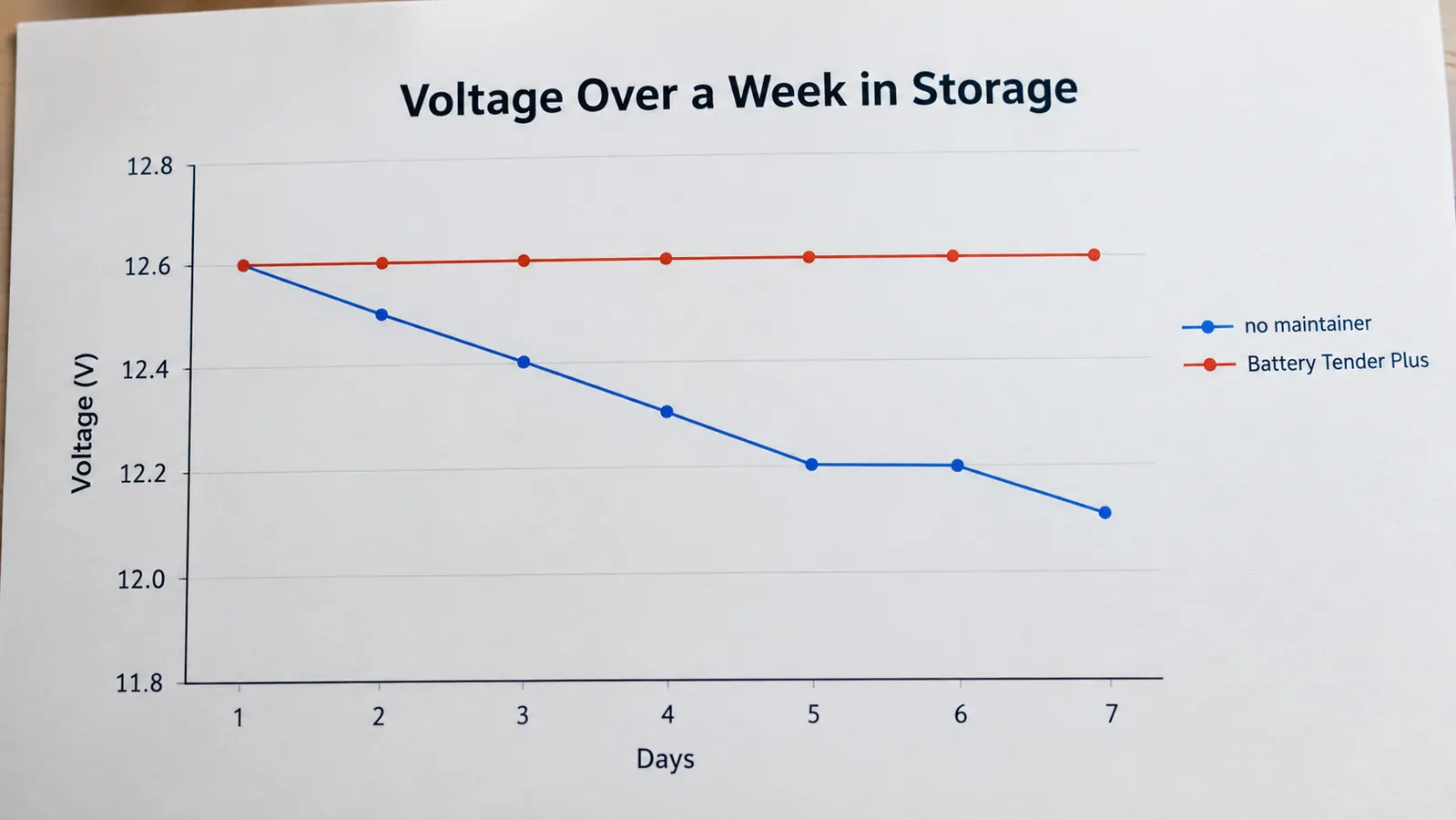
The first winter, I checked the voltage every few days with a multimeter. It held steady at 12.6 volts the entire time. The second winter, I stopped checking. That's the highest compliment I can give a maintainer: you forget it's there.
Here's what the routine actually looks like. I pull the truck in, shut it off, and plug the cord in before I close the hood. When I need the truck, I unplug, coil the cord, and hang it on a nail I put in the wall stud next to the outlet. The whole thing takes under a minute. I put a piece of tape on the cord with the date I first hooked it up, late November two winters back, and it has been connected every winter since. There was one stretch in January with nine straight days below freezing, and the truck sat the whole time. The first crank was slow, the way it always is after a cold soak, but it caught on the second try. That was the moment I stopped worrying about the battery altogether.

What Nobody Tells You About the Charge Rate
Here's the part that trips people up. The Battery Tender Plus puts out 1.25 amps. A typical car battery holds around 50 amp hours. If you run that battery all the way down, which means it's completely dead, the math says it would take roughly 40 hours to bring it back. In practice it's worse, because the unit slows down as the battery recovers. You are not going to charge a dead battery overnight with this thing. You're going to charge it over a weekend, if you're lucky.
I learned this the hard way one February when I came out to the garage and found my truck completely dead. I had left the driver's door ajar for a couple of days while I was reorganizing the bench, and the interior lights had pulled the battery down to around 10 volts. I hooked up the Battery Tender Plus and left it overnight. In the morning the light was still red, the voltage was still below 12, and the truck would not crank. I ended up putting a real charger on it for a few hours, then let the Battery Tender finish the job. That combination worked fine. But if I'd needed the truck that morning, I would have been stuck.
The honest way to think about this unit is as a tool that prevents a problem, not one that fixes it. If your battery is healthy and just needs to stay that way, the Battery Tender Plus is perfect. If your battery is already dead, you need a charger with more amps, and you should probably replace the battery anyway.
Cold makes it worse. A battery accepts charge slower when it's cold, so in the middle of a Scranton winter that 40 hour estimate stretches. I've seen this unit take the better part of three days to bring a battery from about 11.8 volts to a point where the truck would crank. That is fine if you plan ahead and leave it connected. It is not fine if you are late for work and need the truck now. Plan for the slow, and it will never let you down. Expect it to be fast, and you will be disappointed every time.
After a full night on the Battery Tender Plus, the truck still would not crank. That is what 1.25 amps means, and it is the thing nobody tells you.
The Connectors: Which One Should You Use?
The Battery Tender Plus comes with two ways to connect. The first is a pair of alligator clips, which clamp onto the battery posts. The second is the ring terminal harness I mentioned, which bolts on and stays. There's also a cigarette lighter adapter on some versions, but I'll be honest, I've never used it.
My advice is to install the ring terminals and forget about the clips. The clips work fine for a quick top-up, but they can slip off if the cable gets bumped, and they're awkward to reach in a tight engine bay. The ring terminals take ten minutes to install once, and then connecting the maintainer is a one-handed job. I leave the harness on the battery year round, even in summer, because it costs nothing and makes the whole thing effortless.
One thing to watch: the ring terminals are not the heavy duty kind you'd use on a big truck with a massive battery cable. They're adequate for a standard automotive battery, which is what this unit is designed for. If you're working on something with a commercial battery, you'll want a different setup.
Installation is straightforward, but there is one detail worth getting right. The ring terminals slide over the battery posts before the cable clamps go on, so the order matters. Post, ring terminal, clamp, then tighten. If you put the ring terminal on top of the clamp, it can work loose as you tighten the clamp down. I also put a thin coat of dielectric grease on the posts before I bolted everything together, and I check the connection once in the fall before the cold sets in. Loose connections are the reason most maintainer problems show up in January, not November.
One more thing about the clips. They are fine for a battery sitting on a bench, but under the hood of a truck they are a pain. The positive clip is bulky and the cable is stiff, and on the F-150 the battery sits close to the fender, so there isn't much room to get a hand in there. The ring terminals fixed that completely. I keep the clips in the box in case I ever need to maintain a battery that is out of the vehicle, and so far I have not needed them once.
About that cigarette lighter adapter. I never bothered with mine, because it only helps if the outlet stays live with the key off, and on many modern trucks it does not. On my F-150 the lighter outlet goes dead when the ignition is off, so the adapter would be useless for my setup. Check your own vehicle before you rely on it. The ring terminals work on every vehicle, which is why I recommend them.
How It Compares to a Trickle Charger
People use the words trickle charger and maintainer like they're the same thing. They're not. A plain trickle charger pushes a fixed current all the time, which means it can overcharge a battery if you leave it connected for weeks. The Battery Tender Plus monitors voltage and switches to a float charge when the battery is full. That's the difference that makes it safe to leave connected all winter.
I've seen cheap trickle chargers boil batteries dry. I've never seen a Battery Tender do that, and I've used them on everything from lawn mowers to diesel trucks. The smart charging circuit is the whole reason to buy this over a cheap trickle charger. It's also the reason it costs more. You're paying for the electronics, and they're worth it.
Here's what overcharging actually looks like. I've had swollen battery cases come across my bench more times than I can count, with the electrolyte low in every cell, and in every one of those cases the owner had left it on a cheap trickle charger for months. A battery that sits at full charge with a dumb charger pushing current into it will gas, lose water, and eventually bulge. The Battery Tender Plus tops the battery off and then backs off to a float voltage that keeps it healthy without cooking it. That is the difference, and it is a big one.
The float voltage matters more than most people realize. A battery that sits at full charge with no load will slowly lose voltage, and if it drops below about 12.4 volts it starts to sulfate. That sulfate is what kills batteries that sit all winter. The Battery Tender Plus holds the battery right at the edge of full, around 13.2 volts while it is working, then drops back to a maintenance level. I have measured mine at 12.6 volts after weeks on the unit, which is exactly where a healthy battery should sit.
What I Liked
- Holds a battery at a steady 12.6 volts for weeks without overcharging
- Ring terminal harness makes hookup a ten second job
- Safe to leave connected all winter, even in an unheated garage
- Red and green lights tell you exactly what the unit is doing
Where It Falls Short
- 1.25 amp output is far too slow to rescue a dead battery
- The red light can stay on for a full day on a low battery, which worries people who expect a fast charge
- Ring terminals are light duty, not meant for commercial batteries
- There's no display showing exact state of charge, just the two lights
Who This Is For
This is for the person who has a vehicle that sits. Maybe it's a pickup you only drive on weekends. Maybe it's a classic car in storage. Maybe it's a motorcycle, an ATV, a lawn tractor, or a snow blower. If you have something with a battery that goes unused for weeks at a time, the Battery Tender Plus will keep it ready to start, and it will do it safely, automatically, and without you thinking about it.
It's also for the person who wants to extend the life of a battery. A battery that's kept at full charge through the winter will last years longer than one that's allowed to sit and slowly discharge. I've seen batteries die in three years from winter neglect. I've also seen them last six or seven when they were maintained. The Battery Tender Plus pays for itself the first time it saves you from buying a battery.
Who Should Skip It
Skip it if you need to charge a dead battery. If your battery is flat, or even just very low, this unit is too slow to be useful. You'll wait all day and still not have enough to start. You need a real charger with 10 amps or more, and you need to use it before the battery is completely drained.
Skip it if you have a vehicle with a serious parasitic drain. The Battery Tender Plus can keep up with a small draw, like a clock or a radio memory. It cannot keep up with a module that's staying awake and pulling a couple of amps. If your battery keeps dying even with a maintainer on it, you have a wiring problem, not a battery problem, and no maintainer will fix that.
And skip it if you're looking for a single tool to do everything. This is a specialist. It does one job, keeping a healthy battery healthy, and it does that job extremely well. If you need a charger that can also jump start, or charge fast, or work on multiple batteries at once, look at something bigger.
The Bottom Line
The Battery Tender Plus is the most reliable tool in my garage that I never think about. It's not exciting. It's not fast. It's not going to rescue you from a dead battery. But it will keep your truck ready to start every single time you walk out to it, all winter long, and it will do it without boiling your battery or burning down your garage. That's exactly what I need it to do.
If you have a vehicle that sits, buy the Battery Tender Plus. Install the ring terminals, plug it in, and forget about it. Your battery will last longer, your truck will start, and you'll wonder why you didn't buy one years ago. Just don't ask it to do a job it wasn't built for.
The maintainer I trust with my own truck all winter
Two winters, zero dead batteries, zero overcharging. See today's price on Amazon and decide if it belongs in your garage.
Amazon Check Today's Price on Amazon →