
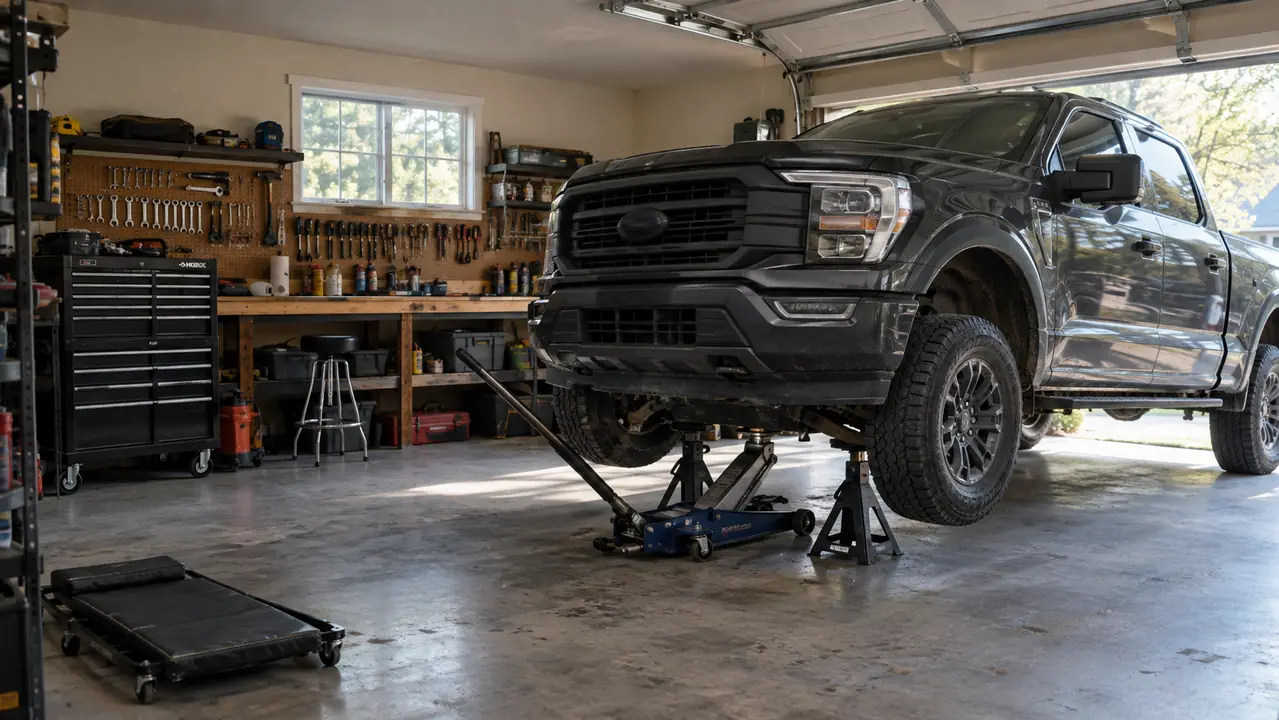
Anybody who has spent a Saturday under a pickup knows the moment a jack stops feeling like a tool and starts feeling like a risk. You set it, you pump the handle, the truck rises, and suddenly you are aware of every bolt and weld in the thing. I have been in that spot more times than I care to count, which is why a BIG RED 3 ton trolley jack has a permanent place in the project bay of my garage. When a neighbor asked whether he should buy the same jack or a low-profile racing jack for his truck, I gave him the honest answer: it depends entirely on what you park on top of it.
I am Ray Duchesne. I spent 30 years turning wrenches on heavy equipment before I retired, and these days I do all the work on my 2014 Ford F-150 in a two-car garage outside Scranton, Pennsylvania. This is not a spec sheet comparison. Both jacks have spent real time under that truck, and one of them also spent time under a neighbor's lowered Mustang, because that is the only honest way to test the difference. The short answer: if you own a pickup, an SUV, or anything with a frame that sits up off the ground, the BIG RED is the tool you want. The low-profile racing jack is the better fit for a car you can barely slide anything under in the first place.
How I Tested Both Jacks
I ran both jacks through the same jobs over a few weekends to keep the test fair: front end up for a brake job, rear end up for a tire rotation, and each corner lifted on its own to check the suspension and the jack's behavior at full extension. The F-150 sits higher than most cars and weighs enough to make a flimsy jack feel flimsy fast, so the test was never gentle. I also carried the racing jack over to my neighbor's garage, because his Mustang sits low enough that my trolley jack will not slide under the front of it without a couple of boards under the tires. That gave me the full picture: each jack working on the vehicle it was designed for, and each one working on the wrong vehicle.
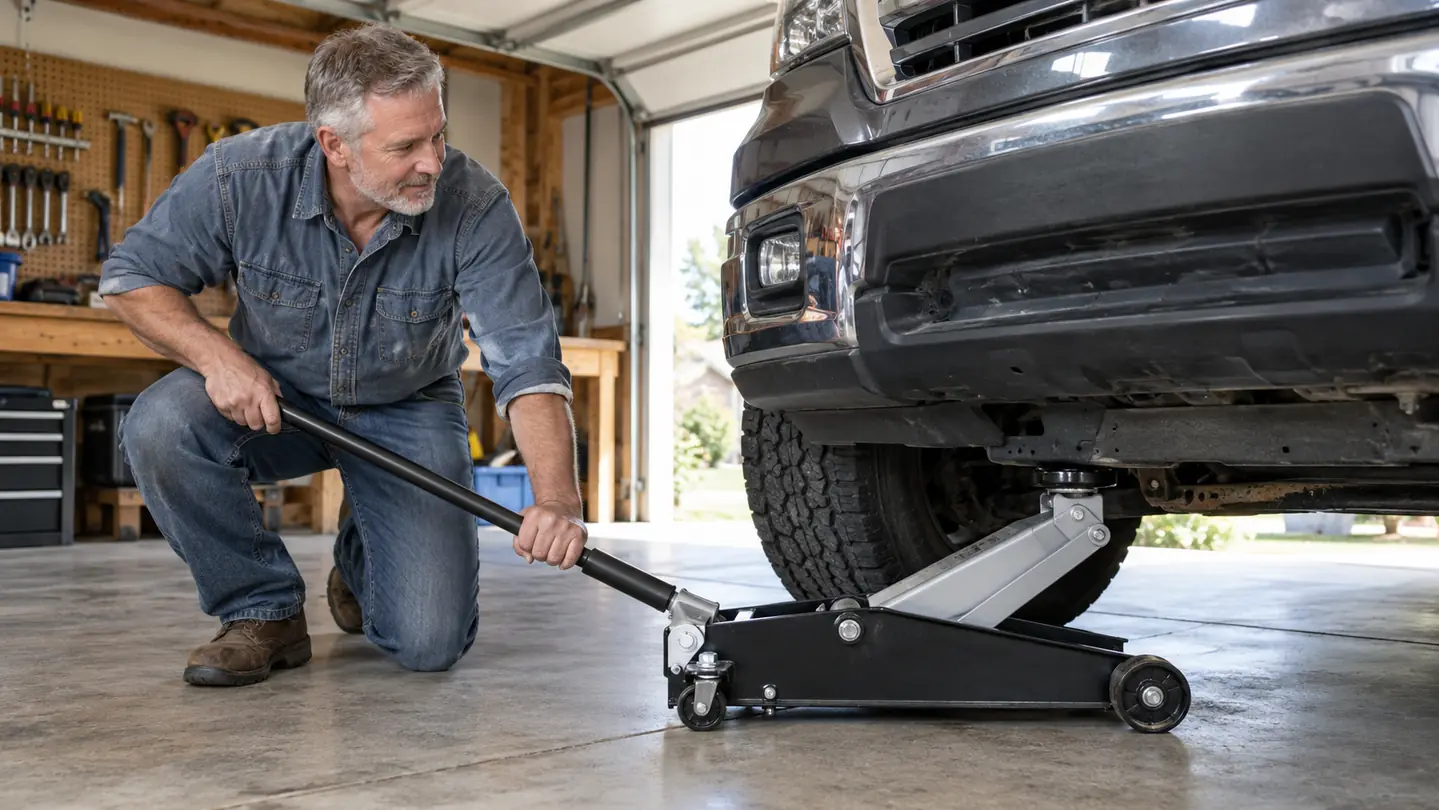
The lift point matters as much as the jack itself. On the F-150, I am usually reaching for the front crossmember or the rear axle housing, and neither one is easy to see when you are on your back. The BIG RED's extra saddle gives me a wider, more forgiving contact patch, so I do not have to line up a small round pad perfectly every time I pump the handle. The racing jack's smaller saddle is built for a chassis rail on a car, and under a truck axle it means more fiddling, more readjusting, and a little less confidence. That difference does not show up in a catalog photo, but it shows up every single time you use the thing.
How They Compare on Paper
Here is the honest breakdown from the two jacks side by side in the garage. I marked a winner in each row based on what actually happened under the truck, not what the box promised. A tie means the two jacks serve different jobs and neither one is wrong.
| BIG RED 3 Ton Trolley Jack | Low-Profile Racing Jack | |
|---|---|---|
| Max lift height | Rides the F-150's frame up to a comfortable working height, with room to spare | Tops out lower; fine for cars, short of a truck that sits tall |
| Minimum height | Sits higher off the floor, around the height of most crossover jack points | Slides under a low front bumper or side skirt that a truck jack cannot fit |
| Capacity | 3 tons (6,000 lb), rated for the F-150 and then some | Often 1.5 to 2 tons, sized for cars and light sports coupes |
| Reach | Longer frame plus extra saddle reaches the front crossmember without a block of wood | Short frame built for chassis rails close to the wheels |
| Stability at full height | Wide stance and big saddle, steady under a tall truck | Narrower footprint, fine at car height, less reassuring up high |
| Best for | Trucks, SUVs, crossovers, anything with a high frame | Low-slung sports cars and anything you cannot get a hand under |
| Storage | Bigger, takes a corner of the garage or a wall hook | Shorter and lighter, tucks behind a bench |
| Value for the money | You pay for capacity and reach you actually use | You pay for low clearance you do not need under a truck |
Where the BIG RED Trolley Jack Wins
The first thing you notice under the F-150 is reach. The BIG RED has a longer frame and that extra saddle, so the saddle lands where it needs to be without me stacking wood blocks like a Jenga tower. Max lift height is the bigger deal. The truck comes up high enough that I can get a jack stand under the frame and still have room to work, and the jack holds that height without settling over the course of an hour. A racing jack built for a car simply tops out lower, and under a truck that means boards, blocks, or a sore back. I have done the sore back version enough times to know the difference.
The second thing is stability, and this is where a 3 ton rating earns its keep. The rating is not bragging, it is margin. At full extension under a 6,000 lb truck, the BIG RED stays planted on its wide base, and I do not think about it again until the job is done. The racing jack's narrower stance is fine at car height, but up where a truck frame sits it feels less settled. I would not call it dangerous. I would call it the wrong tool, because the low profile is a feature you are not using under a truck. When the job is holding a pickup over your chest, the tool should feel like it belongs there.
Where a Low-Profile Racing Jack Wins
I am not going to pretend the racing jack has no case, because it does. Its entire reason for existing is the minimum height. A low-profile racing jack slides under a car that sits only a few inches off the ground, which my BIG RED will not do without ramps or boards. If you have ever lain on your back in a driveway trying to find a jack point on a lowered car, you already know why people buy these things. They are not a gimmick. They are the only tool that fits certain cars, and for the person who owns that car, they are worth every penny. The question is whether that person is you.
The racing jack is also easier to live with in a small garage. It is shorter, lighter, and tucks under a workbench without taking over the bay. My neighbor keeps his behind a shelf and forgets about it until the Mustang needs a tire swapped, and for him that is the right answer. For the right vehicle, that convenience is worth the trade. The catch, and this is the whole point, is that none of it matters under a 2014 F-150. The truck is too tall to need the low profile and too heavy to thank you for a smaller jack. Buying one for a pickup is buying a solution to a problem you do not have.
At full extension under a 6,000 lb truck, the BIG RED stays planted on its wide base, and I do not think about it again until the job is done.
Get the jack that actually reaches your truck's frame.
The BIG RED 3 ton trolley jack with extra saddle lifts the F-150 to a working height a racing jack cannot match, and it holds steady at full extension. Check today's price on Amazon and read the owner reviews before you decide.
Amazon Check Today's Price on Amazon →Who Should Buy Which
Buy the BIG RED trolley jack if you work on a pickup, an SUV, a crossover, or anything with a frame that sits up off the ground, and especially if you want one jack that handles brake jobs, tire rotations, and suspension work without a stack of wood blocks sitting beside it. Buy the low-profile racing jack if your daily driver is a low car, if the car is lowered, or if the only thing between you and a jack point is three inches of air. And if you are like me, with one truck and one garage and no second vehicle waiting in the wings, the answer was never really in doubt. The trolley jack is the one that earns its spot.
The Extra Saddle, Explained
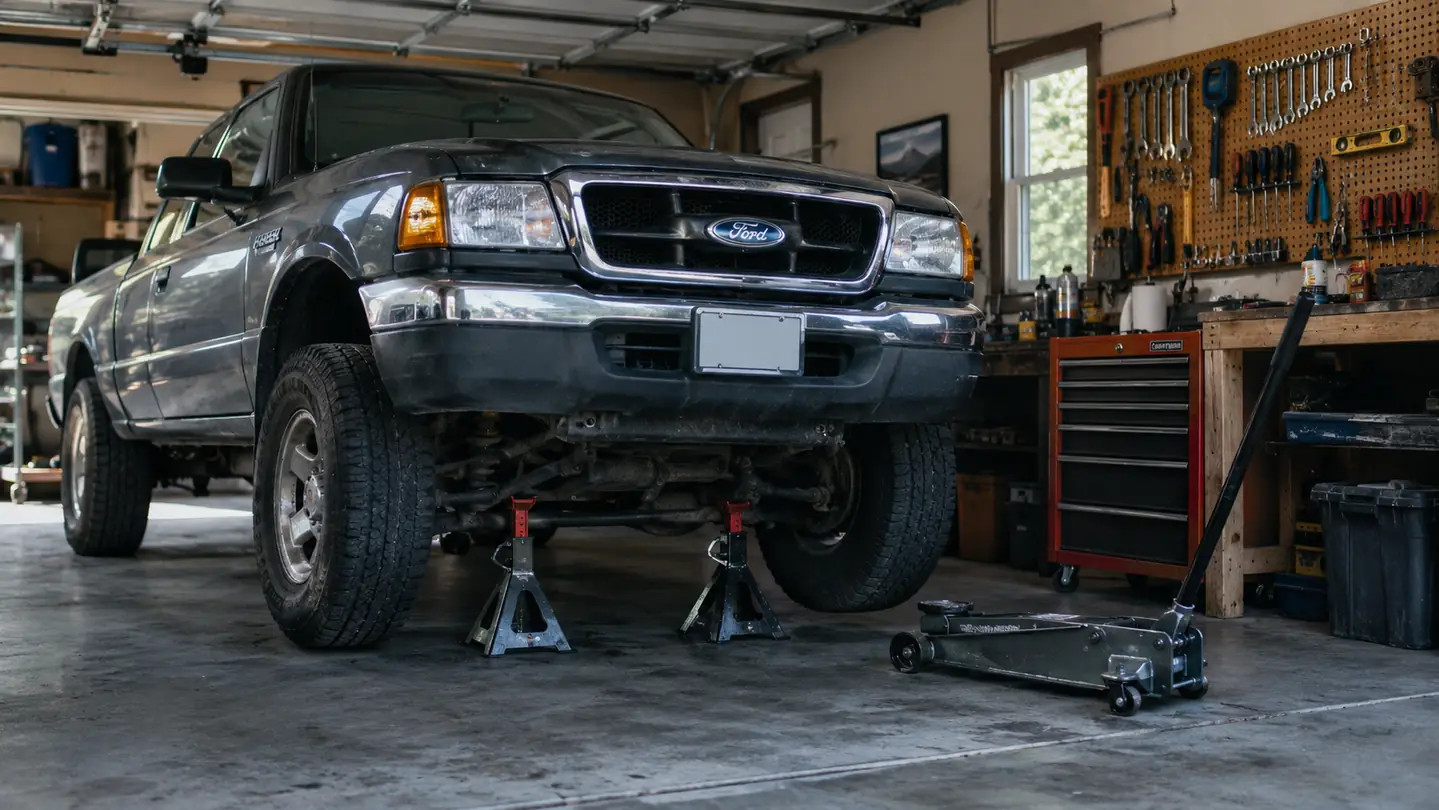
The "extra saddle" in the BIG RED name is not marketing filler. It is a wider top pad that gives you more room to find the right contact point when you are reaching blind under a truck. On a car jack, the small round pad is fine because the chassis rail is narrow and easy to see. On a truck, the axle housing and crossmembers are bigger targets, and a wider saddle spreads the load instead of pressing a dimple into the metal. It sounds like a small detail. In practice it is the difference between a quick lift and a ten minute argument with the jack, and after 30 years in a shop, I will take the quick lift every time.
What I Would Tell a Neighbor
If you are choosing between these two and you own one truck, stop reading and buy the trolley jack. If you are choosing because you also own a low car, buy the racing jack for the car and keep the trolley jack for everything else. The mistake I see people make is buying the racing jack because it looks like the serious tool, then discovering under the truck that it was built for a different job entirely. A jack is not a status symbol. It is a thing that holds a ton and a half of steel over your chest, and it should fit the vehicle like a glove. Buy the tool that fits the job you actually do on a Saturday.
One More Thing Worth Knowing
Both jacks need the same basic respect. I keep the ram and the release valve clean, I never leave a loaded jack holding the truck up overnight without jack stands under the frame, and I store the BIG RED with the piston fully down so the seals stay wet. I also give the saddle a wipe before it touches the frame, because a gritty pad on clean metal is how you get a scratch you will notice for years. A floor jack is a simple tool, and the difference between these two is not quality. Both are built fine. The difference is which job each one was built for, and that is the only question you need to answer before you hand over your money.
Capacity vs Clearance: Which Number Matters More
When people compare jacks, they usually grab the two numbers on the box: capacity and minimum height. Both matter, but they answer different questions. Capacity is about how heavy the vehicle is and how much margin you want under it. Clearance is about how low the vehicle sits and whether the saddle can even get to the lift point. A pickup owner cares about the first number far more than the second, because a truck frame sits high enough that minimum height is rarely the problem. The problem is weight, reach, and how high the jack can push the truck before you run out of stroke.
The low-profile racing jack is a specialist. It trades away capacity, max lift height, and a wider stance to get one thing: the ability to fit under a car that is nearly touching the ground. That is a fair trade when you own that car. It is a waste when you own a truck, because you are paying for a feature the truck never uses while giving up the features it needs every time. The numbers on the box only look similar. The jobs they are built for could not be more different.
Pick the jack that fits the truck you actually own.
The BIG RED 3 ton trolley jack with extra saddle is the one I reach for every time the F-150 goes up. Check today's price on Amazon and see why it earns its spot in the garage.
Amazon Check Today's Price on Amazon →