
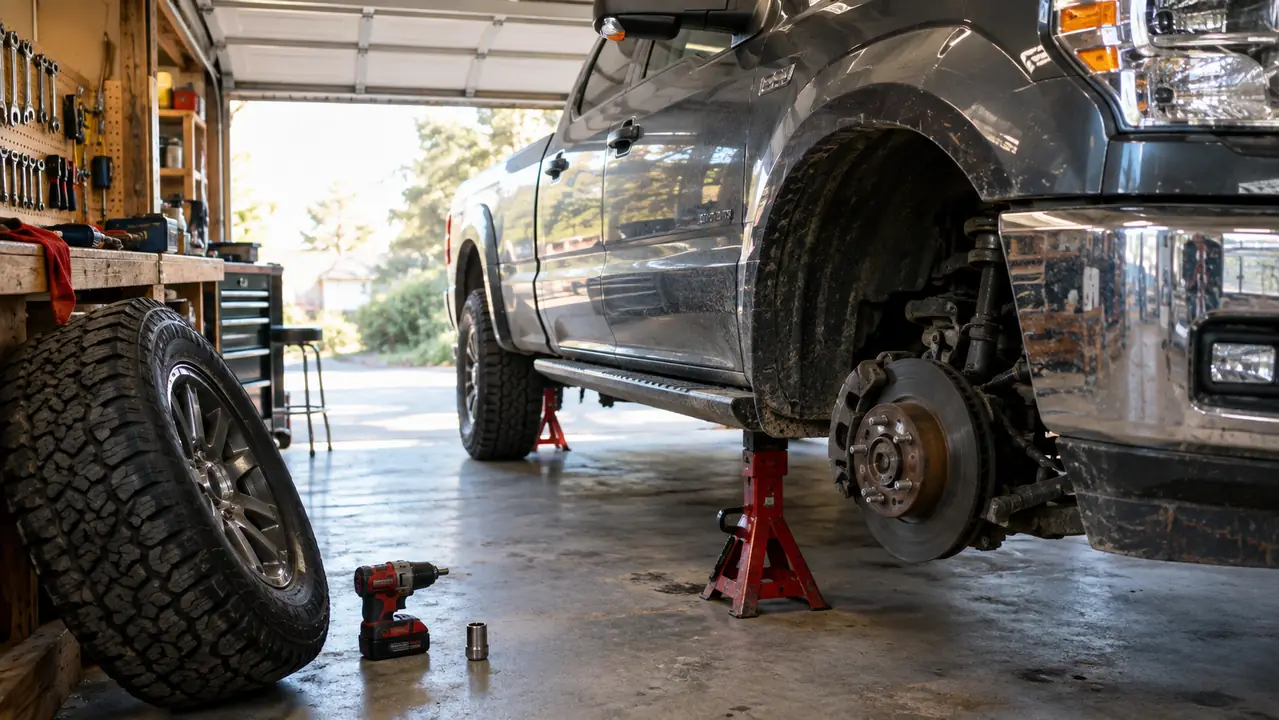
Tire rotation is one of those jobs every pickup owner knows they should do and most put off. The reason is rarely the jacking or the stands. It is the lug nuts. On my 2014 F-150, the factory spec is 150 foot-pounds of torque, and the lug wrench that came under the back seat is not going to make that easy. Thirty years of turning wrenches, most of them on heavy equipment, taught me that the right tool changes the whole job. The DEWALT 20V MAX cordless impact wrench, model DCF900P1, has been in my garage for about a year, and it turned rotation day from a Saturday morning project into a task I can knock out before breakfast.
If you have never used an impact wrench, here is the part that surprises people first: it does not twist a fastener the way a ratchet does. It hammers it. A mechanism inside the tool spins the anvil in short, violent bursts, and each burst lands like a sharp blow instead of a steady pull. That is why a lug nut torqued to 150 foot-pounds comes off with the wrench held in one hand, while the same nut on the end of a breaker bar has you bouncing your weight on the handle. You could take the truck to a shop and let them handle the whole job, and I did for the first few years I owned this pickup. But rotation is a twenty-minute job, and the shop wants the truck for half a day while you sit in the lobby reading a two-year-old magazine. Doing it at home means you see the brakes, the bearings, the tread wear, and the condition of the spare before small problems turn into road calls.
The wrench that takes 150 ft-lb lug nuts off one-handed
The DEWALT DCF900P1 is a 20V MAX brushless impact wrench with more than enough grunt for pickup lug nuts, brake brackets, and suspension bolts. It has done every rotation and brake job in my garage for the past year, and the brushless motor has not missed a beat. If you are still leaning on a breaker bar, this is the tool that ends that.
Amazon Check Today's Price on Amazon →Step 1: Break the lug nuts loose while the truck is still on the ground
The order of operations matters here, and the first step is the one most people skip. With the truck still on the ground, the weight of the vehicle holds the wheel still, so the lug nuts come loose without the wheel spinning on you. Set the parking brake, chock the wheels that are staying down, and crack every lug nut about a quarter turn before you jack anything up.
Break them loose in a star pattern, not in a circle. On a five-lug wheel that means the first nut, then the third one over, then the nut in between, and so on, so the load never shifts to one side of the hub. On the ground the wheel is not going anywhere, so the pattern matters less here than it does when you tighten the nuts back up, but it is a good habit to build.
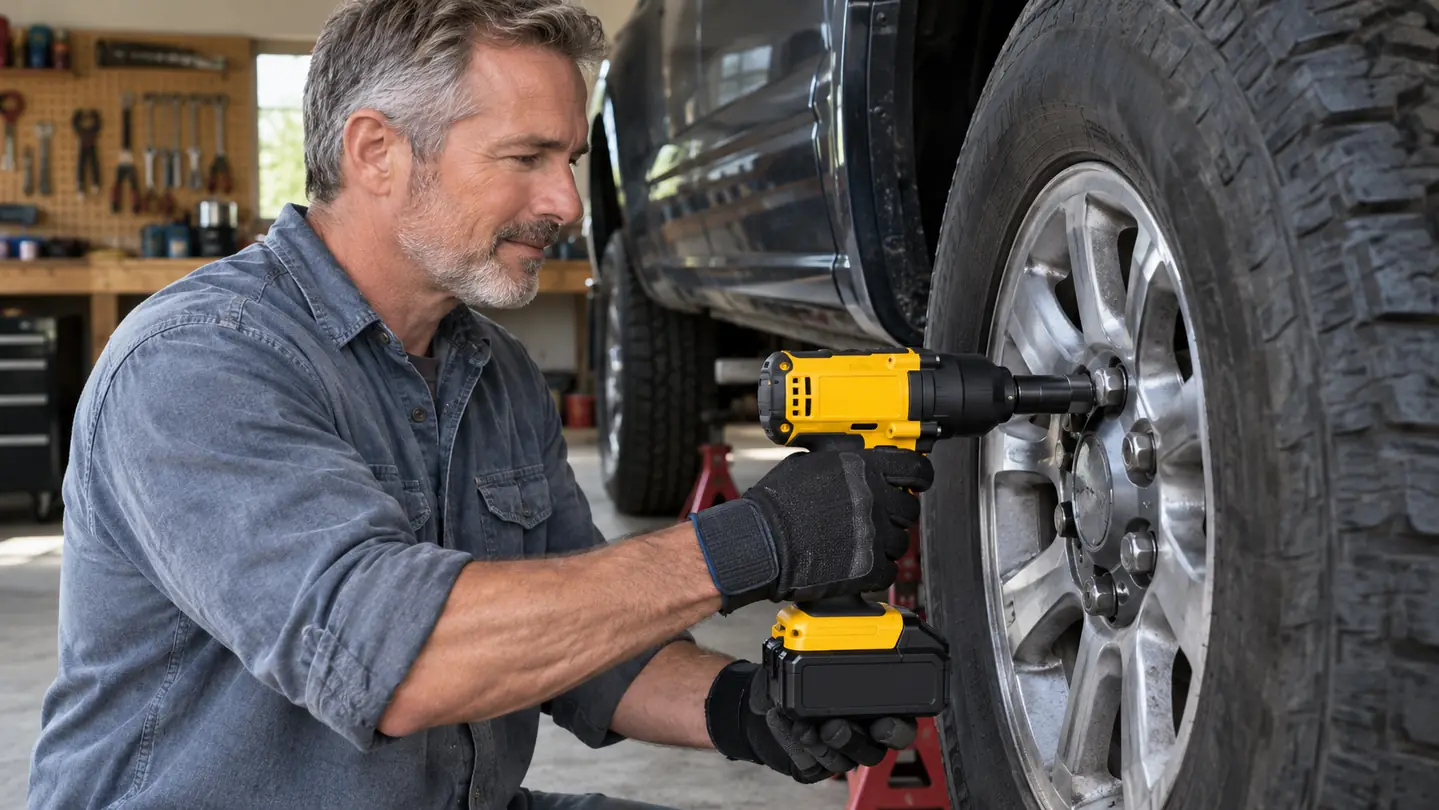
This is where the impact wrench earns its keep. I run the DCF900P1 on its lowest speed setting just to crack the nuts, because there is no point hammering at full power while the tire is still planted. Each nut comes loose in a second or two. If you have ever bounced on the factory lug wrench trying to move a rusted nut, you know the difference between five grinding minutes and one clean pop.
Step 2: Jack it up and set it on stands, never on the jack alone
The hydraulic jack lifts the truck, and the jack stands hold it up. That division of labor is not optional. For a half-ton pickup the front and rear jacking points are marked in the owner's manual, and I set the saddle on a block of wood so the frame rail does not get dented. Raise the truck, set the stands, and give the bumper a hard shove before you put any part of yourself underneath. If it moves, fix the stands before you go further.
For a full rotation you will have all four wheels off at some point, which means you want the truck supported at both ends at once. I use a pair of six-ton stands under the frame rails and move them as I work around the truck. Six tons is overkill for a half-ton pickup, but overkill is cheap compared with a truck that settles onto your foot because a stand was undersized or sitting on soft ground. Both stands get set on a hard, level surface, never on gravel or loose dirt.
With the truck in the air, spin each wheel by hand before you pull it. You are listening for a grind and feeling for a rough spot in the bearing. Rotation day doubles as a free inspection day, which is the whole point of doing the job at home. If something feels wrong, this is the moment to catch it, not three months later on the interstate.
Step 3: Move the wheels in the pattern your truck calls for
The rotation pattern depends on whether your truck is two-wheel drive or four-wheel drive. On a rear-wheel-drive pickup, the rear tires move straight forward to the front axle and the front tires cross to the rear. On a four-wheel-drive truck like mine, the common pattern is the reverse: the front tires go straight back, and the rear tires cross up to the front. The exact pattern can vary with tire type, so the owner's manual is the final word, and I have seen a truck wear out a set of tires in fifteen thousand miles because the rotation pattern was wrong.
The exact pattern gets argued about in every garage I have ever worked in, and the honest answer is to follow the manual for your truck. What does not change is the reason for rotating at all. The front tires on a pickup carry the weight of the engine and do all of the steering, so they wear the outside shoulders faster than the rears. Swapping the positions evens that out and gets you closer to the full tread life you paid for.
Before any wheel goes back on, I wipe the hub face clean with a rag and put a thin coat of anti-seize on the hub pilot. I do not put anti-seize on the studs or the threads. Clean, dry threads give you a true reading on the torque wrench, and a thin film on the pilot keeps the wheel from rusting itself onto the hub over the winter. That one step is the difference between a wheel that comes off easily next season and one that needs a hammer and a lot of language.
Step 4: Hand-start every lug nut before the wrench touches it
When the wheel is back on the hub, start every lug nut by hand and spin it down until it is snug against the wheel. An impact wrench can cross-thread a nut faster than you can react, and a cross-threaded stud on a truck that works for a living is an expensive afternoon. Running the first pass by hand costs you two minutes and removes the whole class of problems.
After the nuts are started, seat them in a star pattern a little at a time so the wheel pulls flat against the hub. If you run one nut all the way down and then move to the next, the wheel can sit on a slight angle, and you will feel that as a vibration at highway speed that no amount of balancing will cure. The wheel has to seat itself evenly, and the star pattern is what lets it do that. If the wheel is not seating, you will feel it when the truck comes down, and you get to do the job over.
The DEWALT impact wrench has a variable speed trigger, and the low end is gentle enough to seat a lug nut without yanking the wheel out of your hands. It also has a work light at the base of the head, which I appreciate in January when the garage heater has only just taken the chill off. Neither feature is why I bought the tool, but both make it easier to live with.
Step 5: Lower the truck and torque every nut to spec
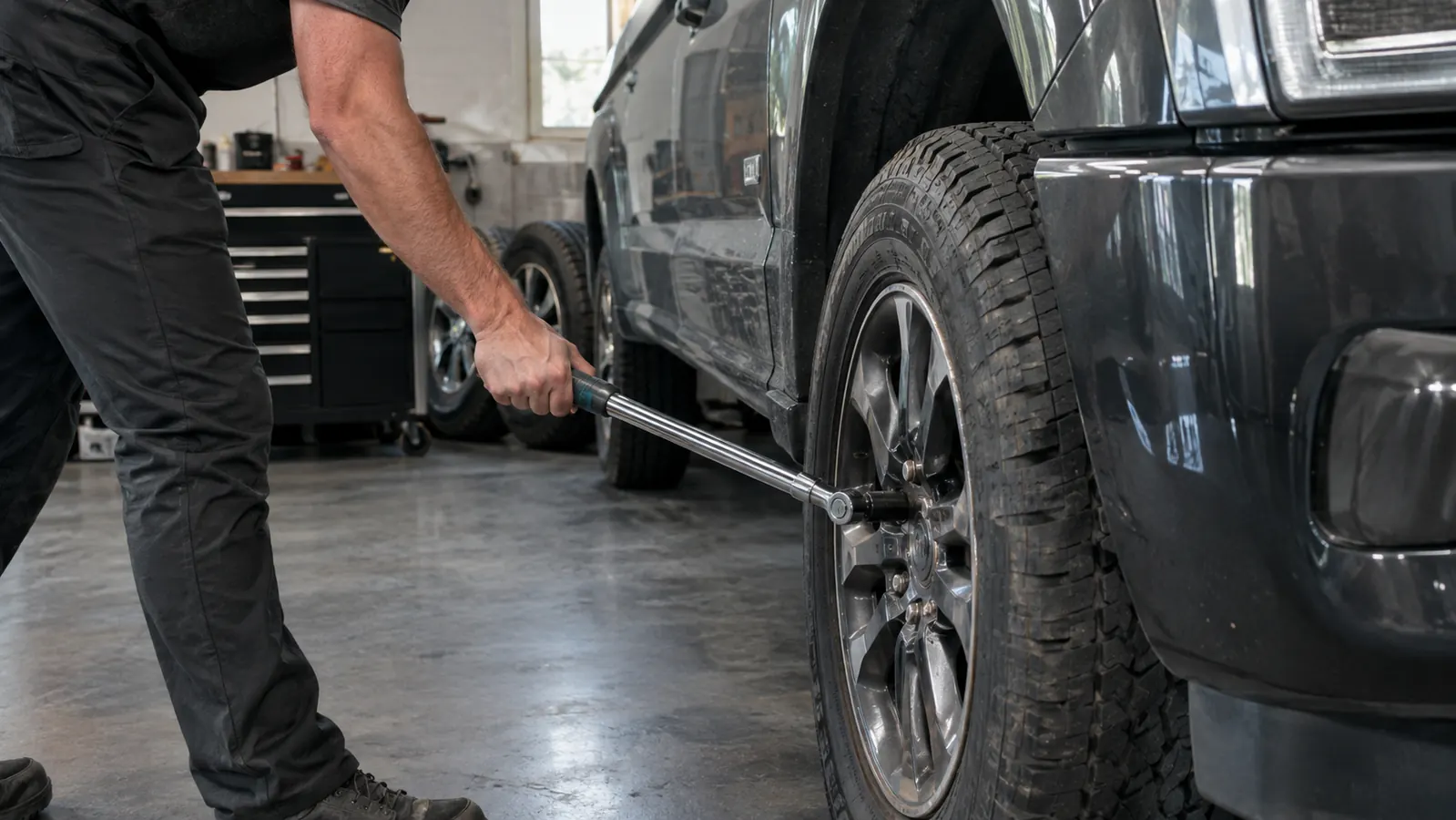
Here is the step that nobody talks about, and the one that matters most. The impact wrench gets the lug nuts cinched down, but it does not torque them consistently. On my truck the spec is 150 foot-pounds, and the only way to know that every nut is at 150 is to finish the job with a click-type torque wrench. I lower the truck off the stands, get the weight back on the tires, and go around the star pattern once with the torque wrench set to spec.
Why bother, when the impact wrench was so fast? Because an undertorqued wheel rocks on the hub and works the studs loose on its own, and an overtorqued stud is stretched and ready to snap at the worst possible moment. Both failures tend to show up at highway speed, usually far from home. Running a torque wrench over all twenty-four lug nuts once a year takes ten minutes and removes the entire category of bad surprises.
I keep my torque wrench in its case on the pegboard so it does not get knocked around in the drawer, because a torque wrench that has been dropped is a torque wrench you cannot trust. A torque wrench is a measuring instrument, treat it like one, and it will stay honest for years. If you do not own one, buy it before you buy the impact wrench. The impact wrench makes the job fast. The torque wrench is what makes sure the job stays done.
What Else Helps
The two main tools are the impact wrench and the torque wrench, but a few small things make rotation day go smoother. You want a six-point socket in the right size for your lug nuts, a floor jack with enough reach to lift a pickup, a pair of jack stands rated for the weight, and a set of wheel chocks so the truck cannot roll while it is up. None of it is exotic, and most of it probably lives in a drawer already.
The other thing that helps is a plan for the spare. Check its pressure and its condition while you are in there, because a spare that rides in the bed or under the frame for years can be as bald and cracked as the tires you are trying to save. If your truck carries a full-size spare, it belongs in the rotation pattern. If it is a temporary spare, it does not, but it still needs air the day you need it.
Finally, do the job on a level surface, in daylight or under a good work light. I know it sounds like a line from a safety film, but it is the difference between a routine job and a trip to the emergency room. Thirty years in a shop taught me that the accidents that happen are the ones you told yourself were not going to happen. Level ground, chocks, stands, and one minute spent shaking the truck before you get near a wheel. That minute of shaking the truck has never once come up empty for me.
The impact wrench gets lug nuts off and on faster than anything I have used in thirty years. The torque wrench is what makes sure they stay on.
Make rotation day a twenty-minute job
The DEWALT DCF900P1 has done every rotation and brake job in my garage for a year now, and it has never left me with a lug nut I could not move. It makes the jobs you are avoiding into the jobs you stop dreading. If you are still leaning on a breaker bar, this is the upgrade that sticks.
Amazon Check Today's Price on Amazon →