
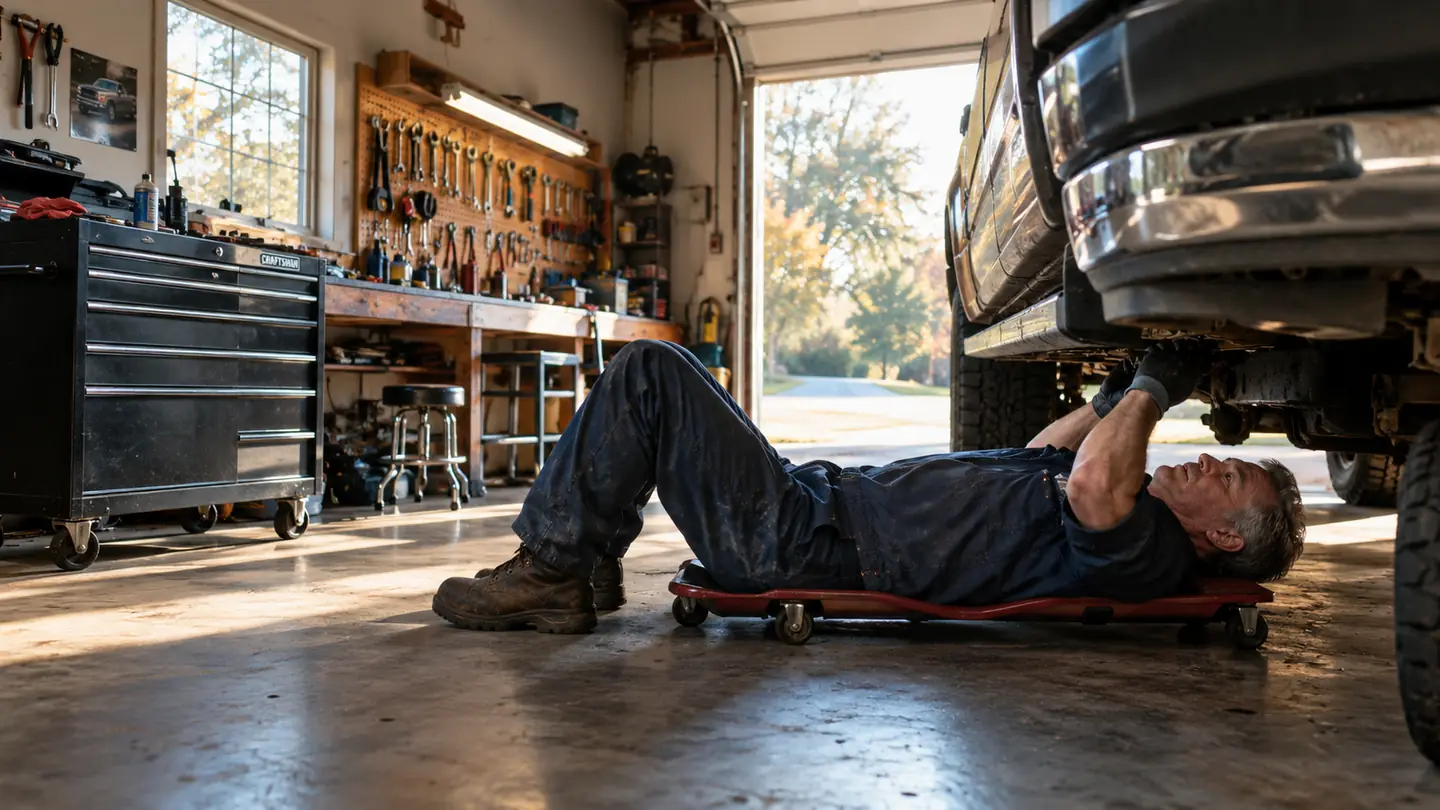
At 57, I've earned the right to be picky about what I lie on. Thirty years as a heavy-equipment mechanic put me under machines more times than I can count, and my hips and lower back have kept a running tally. So when my 2014 F-150 needed a transmission drop last fall, I grabbed the Pro-LifT creeper and rolled under the truck without a second thought. Two hours later, I finished the job and stood up without the usual stop-and-stretch shuffle. That has not always been the case.
Here's what nobody tells you about creepers. The floor matters more than the creeper. You can buy the most comfortable, best-rolling model made, and a rough garage floor will turn every job into a wrestling match. The Pro-LifT is a good creeper. It is not a cure for a bad floor, and once you accept that, it gets a lot easier to decide whether it belongs in your garage.
The Quick Verdict
A comfortable, well-padded creeper that rolls beautifully on smooth concrete and lets you know, loudly, when your floor is not smooth. The wheels are the weak link, and the floor is the real story.
Amazon Check Today's Price →The creeper I reach for every time I slide under my F-150
If your back is done with cold concrete and your garage floor is reasonably smooth, the Pro-LifT is the honest pick. It doesn't try to be the flashiest creeper on the market. It just does the job without drama.
Amazon Check Today's Price on Amazon →How I've Used It
I bought this creeper for one reason. My back was done with the old cracked-foam creeper I had been rolling on for years, the kind where you can feel every frame rail through the padding after ten minutes. My garage is a detached two-car with one bay for projects and one bay for my truck, and the floor is decent smooth concrete with a few expansion joints. That's the surface this creeper was built for, and on that surface, it's a pleasure to use.
Since it arrived, I've used it for two brake jobs, three oil changes, and the transmission drop I mentioned. The transmission job is the real test. You spend two hours on your back with your arms up inside the truck, and whatever you're lying on becomes the whole story. The Pro-LifT carried me through that job with my hips and lower back still speaking to me at the end. Diane asked the next morning whether I was going to be able to walk. I was.
I also made the mistake of rolling it out onto the driveway one warm afternoon to do a quick oil change. That's when I learned what the casters think of asphalt. I'll get to that in a minute, because it's the honest part of this review and the part the product photos leave out.
Padding and Comfort: Where It Earns Its Keep
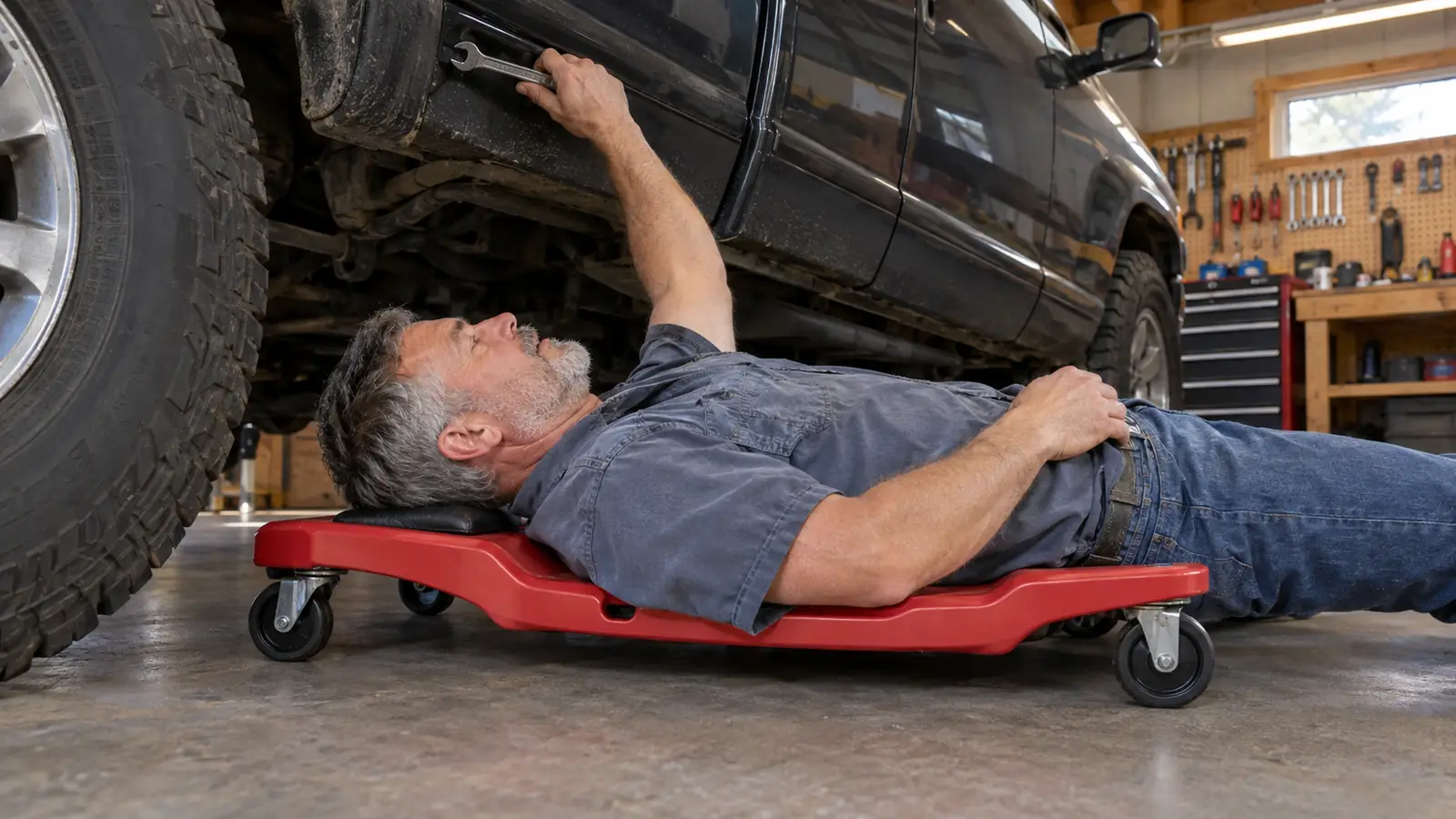
The padding is the first thing you notice, and it's the reason most people pick this creeper over a bare-frame model. The foam is thick enough that you don't feel the frame rails underneath you, which is the failure mode of cheap creepers. On my old one, I could map every crossbar with my lower back after a few minutes. On the Pro-LifT, the padding spreads your weight evenly, and the frame stays out of the conversation entirely.
The headrest is the second thing, and it matters more than you expect. It sounds like a small detail until you spend an hour with your head tilted back, staring up at a brake caliper. The headrest takes the strain off your neck, and on a long job that counts for as much as the padding under your hips. It's the difference between standing up stiff and standing up ready for the next task.
I'll be honest about the limits. This is not a mattress, and you shouldn't expect it to be one. After two hours on my back, I was ready to get up and stretch. The padding is firm, which is good for control while you're wrenching, but it's not plush. If you want a creeper you can nap on between jobs, keep looking.
Getting on and off is easier than I expected, which matters more as you get older. The platform sits low, but it's wide enough that you can roll onto it from a kneeling position without doing the awkward shuffle that cheap creepers force on you. I mention it because nobody tests that in the product photos, and it's the first thing you'll notice on your first job.
The Wheels: Where It Struggles
Here's the honest part of this review. The casters are good, but they're picky. On smooth, clean concrete, the Pro-LifT glides with a nudge of your elbow. You can roll yourself from the bumper to the transmission without touching the floor, which is exactly what you want when both hands are full of tools. On that surface, the wheels are a genuine strength.
On anything rougher, the wheels let you know. My garage floor has expansion joints, and every time I cross one, the casters catch and stutter. On the driveway asphalt, it was worse. The small wheels grab at every pebble and crack, and a smooth slide becomes a series of small jerks. It still works, but it's not pleasant, and you'll find yourself planning your roll path around the worst parts of the floor.
The other thing nobody tells you is that casters collect debris. A few weeks of rolling around in a garage that gets tracked with leaves and grit, and the swivels start to feel gritty. The fix is simple. Blow the wheels out with an air hose and keep the floor swept. But if you're the type who never sweeps the garage, the casters will be the first thing you complain about, and you'll complain about them every single job.
One more thing about the wheels. When the floor is clean, you can push yourself under the truck and back out again with one hand, which leaves your other hand free to hold the part you're working on. That sounds minor, but when you're holding a brake rotor and lining up bolts, it's the difference between a smooth job and a lot of swearing.
Floor Surfaces and Clearance: The Real Story
Let me put this plainly. The Pro-LifT is a garage-floor tool, not a driveway tool. It wants smooth, clean, reasonably level concrete, and on that surface it's a genuine pleasure. On rough sealed concrete, on asphalt, or on a floor covered in oil and grit, the wheels will fight you the whole time, and no amount of padding will fix that. The floor is the real product. The creeper is just the part you lie on.
Clearance is the other thing to check before you buy. The Pro-LifT sits low, which is exactly what you want for sliding under a pickup truck. My F-150 gives me enough room to roll underneath with the creeper and still have a few inches to spare. But if your vehicle sits lower, or if it has skid plates or a low-hanging exhaust, measure before you commit. Low profile is a feature right up until the moment it's not.
That's the part the product photos don't show you. They show the creeper on a clean showroom floor, which is fair, because that's the surface it was made for. They don't show what happens when you cross a cracked expansion joint with a socket in one hand and your other arm up inside a wheel well. It's fine. It's just not as smooth as the photos suggest, and knowing that before you buy is worth something.
One tip if your floor is borderline. A shop vac and ten minutes of sweeping will do more for this creeper than any upgrade you can buy. I sweep the bay before I roll it out, and the casters thank me every time. It sounds too simple to matter, but it's the difference between a creeper that glides and one that fights you all afternoon.
Frame and Build Quality
The frame is where the Pro-LifT shows its working-class roots. It's rigid, and it doesn't flex when I roll my full weight onto it, which is more than I can say for the flimsy folding creepers I've used over the years. The welds are clean, the finish has held up through a Pennsylvania winter in an unheated garage, and nothing has rattled loose. For a tool that lives under a workbench and gets dragged out for dirty jobs, that's exactly what I want.
The one thing I'd change is the casters themselves. Not because they're broken, but because they're the part most likely to wear out first, and they're the part you can't easily swap for better ones if the fitting doesn't match. If Pro-LifT offered a version with larger, sealed bearings, I'd buy it in a heartbeat. As it stands, keep the wheels blown out and the floor swept, and they'll treat you fine.
The creeper also handles side-to-side movement better than I expected. When you're under a truck and need to shift a few inches to reach a different bolt, you can rock your hips and the whole platform moves with you. Cheaper creepers twist under that kind of motion, and you end up fighting the frame instead of the truck.
One small gripe. There's no built-in place for a wrench or a socket, so you'll still be reaching for the magnetic tray you already own. That's not a knock on this creeper specifically, every flat creeper has the same limitation, but it's worth knowing before you buy so you're not surprised on the first job.
Alternatives I Considered
Before I settled on the Pro-LifT, I looked at the cheap no-name creepers that show up online by the dozen, and I looked at the folding creepers that are easier to store. The cheap ones lose on padding, and after thirty years in the trade, I'm done lying on foam that feels like a gym mat stretched over a pipe. The folding ones lose on rigidity. Every folding creeper I've tried has a little flex in the middle, and flex means your lower back does the work.
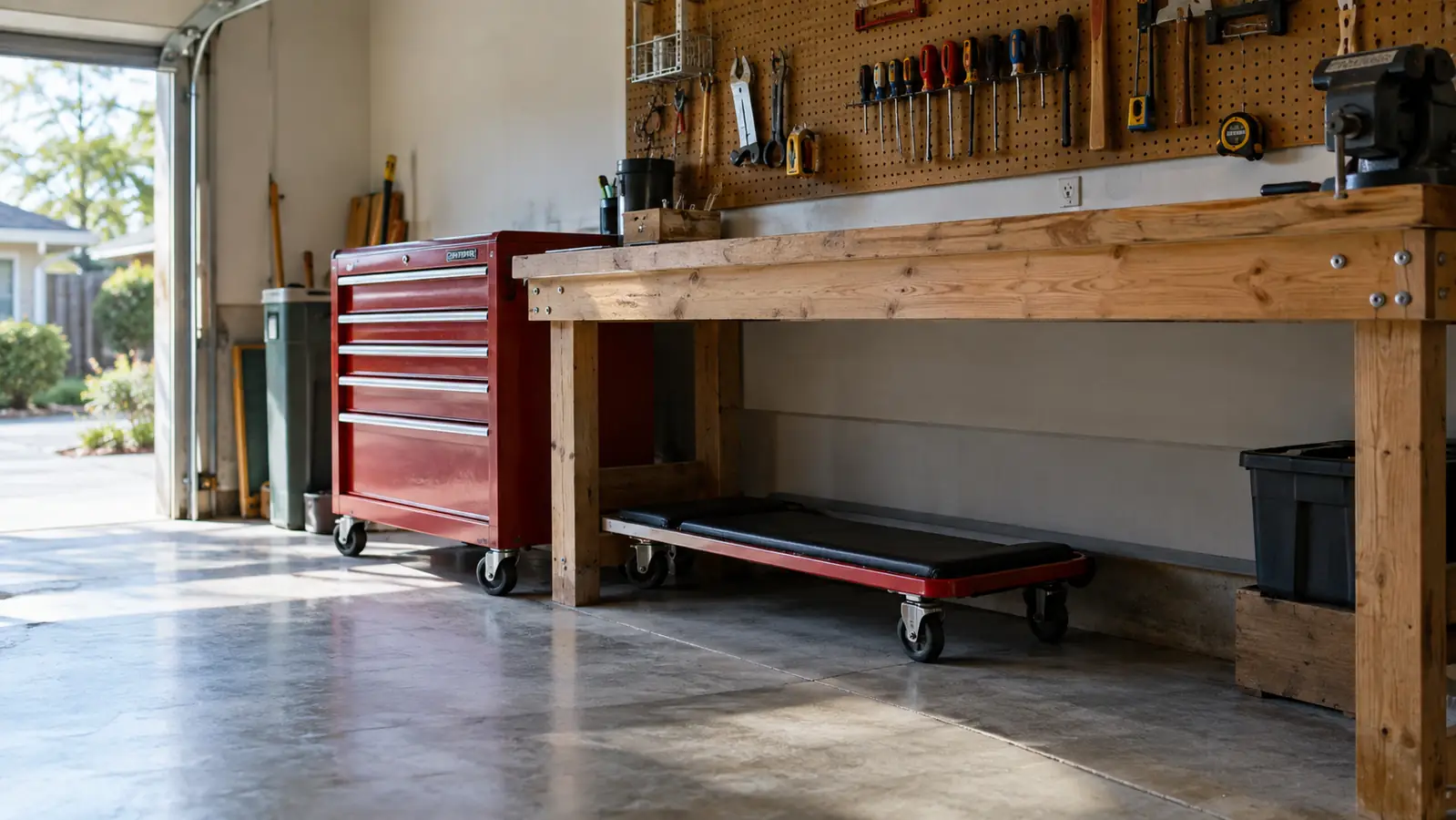
The Pro-LifT splits the difference. It's a solid, low-profile platform with real padding and decent wheels, and it doesn't try to be anything it's not. The tradeoff is storage. It's long, and it doesn't fold, so you need a place to put it. I keep mine under the wooden workbench along the back wall of my garage, and it disappears down there until I need it. If you have nowhere to store a full-length creeper, the folding kind is worth a look instead.
I also considered a creeper with a tilting backrest, the kind that lets you sit up partway while you work. It sounded useful, but every model I looked at was heavier and harder to slide under a low truck. For the work I do, the extra weight isn't worth the occasional moment of sitting up. I'd rather have a creeper that slides easily and use my elbows to prop myself up when I need to.
What I Liked
- Thick padding that keeps the frame rails out of your back on long jobs
- Low profile that slides under a full-size pickup with room to spare
- Rolls smoothly and easily on clean, smooth concrete
- Padded headrest takes the strain off your neck
- Rigid frame with no flex, even under a full-size adult
Where It Falls Short
- Small casters catch and stutter on expansion joints and rough floors
- Not a driveway tool, asphalt will fight you the whole time
- Full length, so it needs a place to live when you're not using it
- Padding is firm rather than plush on marathon jobs
- Casters pick up grit and need an occasional blow-out with an air hose
I slid under my F-150 for a two-hour transmission job and my hips didn't start complaining until the last half hour. That's the first time that has happened in years.
Who This Is For
If you work out of a garage with a reasonably smooth concrete floor, and you're the type who does your own brakes, oil changes, and the occasional bigger job, the Pro-LifT is a straight answer. It's the creeper I reach for every time, and the 28,000-plus ratings on Amazon tell me I'm not the only one who feels that way. At my age, the padding and the headrest are worth more than the twenty minutes I used to spend trying to get comfortable on the old one.
Who Should Skip It
If your floor is rough, if your driveway is your work surface, or if you never sweep the garage, this creeper will frustrate you. The wheels are the weak link, and a rough surface makes that weakness the whole experience. You'd be better served by a creeper with larger wheels, or by fixing the floor first. And if you're a bigger guy, check the weight rating before you buy. The frame handles my build without complaint, but your number should be confirmed by the manufacturer, not by me.
Bottom Line
The Pro-LifT is a good creeper with one honest caveat. It wants a smooth floor, and it'll tell you, loudly, when your floor isn't smooth. On the surface it was built for, the padding, the headrest, and the low profile make it the most comfortable creeper I've owned in thirty years of turning wrenches.
If you have a smooth floor and a sore back, this is the creeper I'd buy again. If your floor is rough, fix the floor first, then buy the creeper. That's the whole honest review in two sentences.
Done with cold concrete? This is the one.
The Pro-LifT is the creeper I'd buy again tomorrow, with one honest condition. Your floor has to be reasonably smooth. If it is, the padding, the headrest, and the low profile will earn their keep on every job you slide under. If it isn't, fix the floor first, then buy the creeper.
Amazon Check Today's Price on Amazon →