
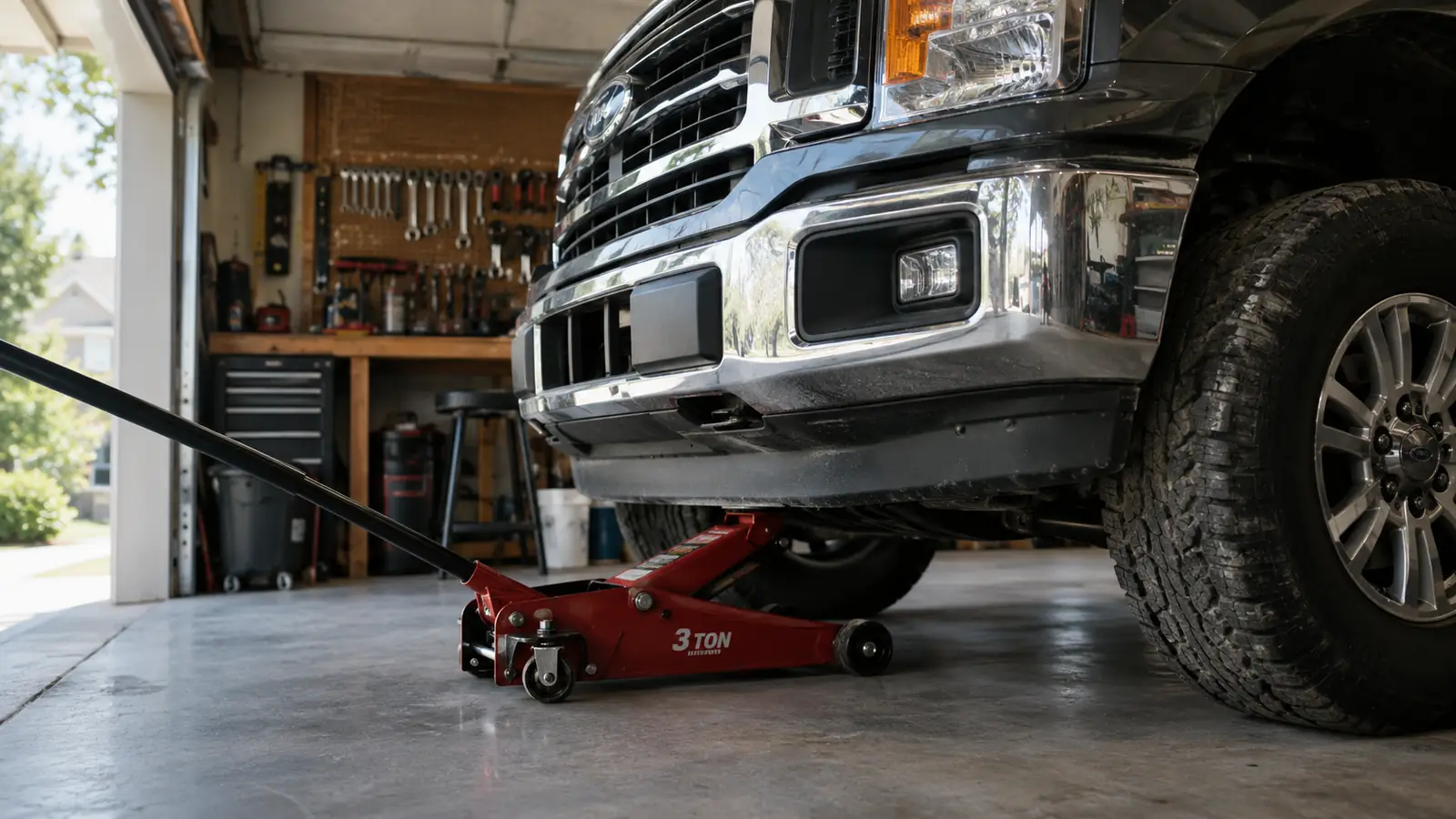
I have been turning wrenches for thirty years, and I have owned more floor jacks than I can count. So when I tell you the BIG RED T83006 has been under my 2014 F-150 for the better part of a year, I mean it has been the jack I reach for first, every time. But honest is honest: it has quirks, and a couple of them will annoy you if you are used to a more expensive unit. This is the review I wish somebody had handed me before I bought it.
The short version is that the BIG RED 3 ton floor jack is a lot of jack for the money, and it has earned its place in my garage. But there are things the product page does not tell you, and a few of them matter. Let me walk you through what a year of real use looks like.
The Quick Verdict
A genuinely capable 3 ton jack that lifts my F-150 without drama, once you learn its two quirks: the tall saddle and the handle that needs a firm hand.
Amazon Check Today's Price →The 3 ton jack I trust under my own truck
After a year of oil changes, brake jobs and tire rotations, the BIG RED T83006 is the jack I reach for first. See today's price on Amazon and decide if it belongs in your garage too.
Amazon Check Today's Price on Amazon →How I've Used It
My F-150 is a 2014 model, and I do all the routine work on it myself: oil changes every five thousand miles, brake pads, tire rotations, and the occasional suspension job. Five thousand miles comes to roughly every eight weeks on this truck, so the jack gets used at least twice a month, sometimes more. It has lifted the front end for oil changes, the rear end for brake work, one corner at a time for tire rotations, and it has sat under the frame for whole afternoons while I worked through a job.
The truck weighs around 5,500 pounds empty, so the front axle is roughly 3,000 pounds and the rear is around 2,500. The BIG RED is rated for 6,000 pounds, which means I am never close to its limit. That is exactly how I like it. A jack that is working near its rated capacity is a jack that is working too hard.
I have also used it to lift a neighbor's Chevy Tahoe when he needed to swap a rear wheel bearing, and a friend's half-ton Silverado for a transmission pan drop. It handled both without complaint, and neither vehicle needed a block of wood under the saddle. The extra saddle height is the reason I bought it, and it is the reason I would buy it again.
The first real test came on a Saturday in late October, the day I did the front brakes. The caliper bracket bolts were rusted on, and I had the truck up on stands for the better part of four hours. The jack sat loaded the whole time and never settled a quarter of an inch. Then in January, with the garage at nineteen degrees before the portable heater caught up, the hydraulics turned slow and deliberate. Not stiff, just slower, the way any hydraulic tool behaves when it is cold. It still lifted the front axle for an oil change without complaint, which is more than I can say for the old jack once the weather turned.
The Saddle Design: The First Thing You Need to Know
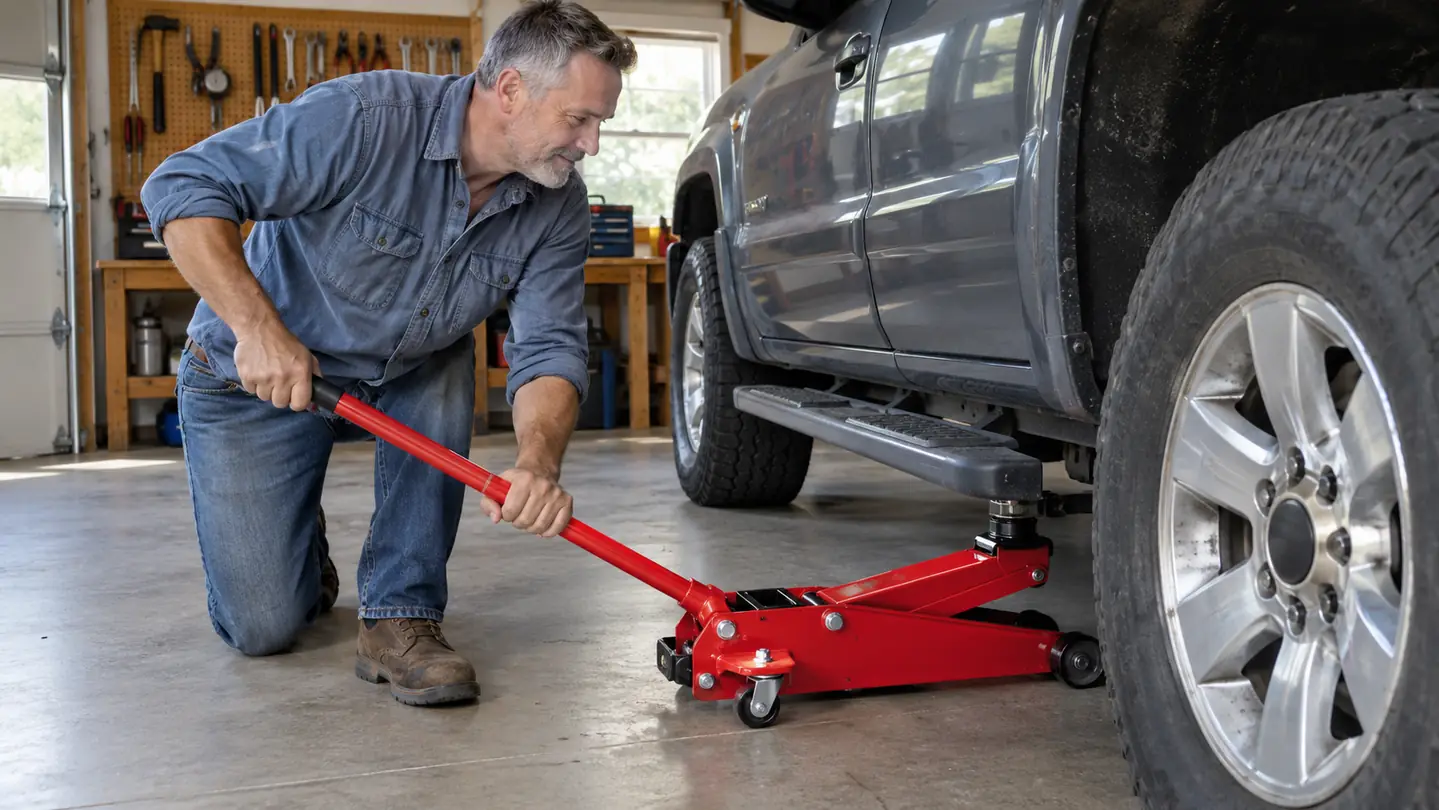
The BIG RED T83006 comes with what the company calls an extra saddle. That is not marketing talk. The saddle is noticeably taller than the one on a standard 3 ton jack, and it is the single biggest reason this jack works so well on trucks and SUVs. On my F-150, the jack reaches the factory lift points without me having to stack a block of wood on top, which is something I had to do with my old jack every single time.
But here is the tradeoff nobody tells you. The tall saddle means the jack does not slide under a low car as easily. If you drive a sedan with a low front bumper, you will find yourself reaching for a block of wood or a different jack. The BIG RED is built for trucks, SUVs and anything with a decent amount of ground clearance. That is its job, and it does that job well.
The spec sheet lists the minimum height at about five and a half inches and the maximum at just over twenty. I have not verified either with a tape measure, but I have been close to both and the numbers feel right. What matters more is the saddle itself. On a standard 3 ton jack the saddle top sits a good three inches lower, and that gap is the whole difference between reaching the F-150's lift point clean and reaching for a chunk of 2x6. I keep a short piece of 2x6 in the garage for the neighbor's sedan, and I have not needed it once for my own truck.
One thing I learned the hard way: the tall saddle changes where you set the jack before you pump. With my old jack I could slide it under, pump twice, and the saddle would meet the frame somewhere in the right neighborhood. With the BIG RED I have to position the saddle directly under the lift point before I start, because the extra height leaves less room to nudge it sideways once it is under the truck. It takes one extra look before you pump. After a month it is automatic, but the first few times I found myself a couple of inches off and had to lower the truck and start over.
The Handle: A Quirk You Will Notice Immediately
The handle on the BIG RED is a two-piece design that locks together with a collar. It works fine, but it takes a firm twist to get it seated properly. If you do not lock it all the way, the handle will wobble when you pump it, and that wobble makes the whole jack feel cheaper than it is. Once you learn the trick, it takes two seconds, but it is the kind of thing that makes a first-time user think they bought a dud.
The handle also has a bit of play in it even when it is locked. It is not enough to affect the lift, but it is there. If you are coming from a jack with a machined handle that clicks into place with zero movement, you will notice the difference. It has never caused me a problem, but I want you to know it before you buy, not after.
The tall saddle is the reason this jack works on trucks, and the wobbly handle is the reason some people send it back. Both are true at the same time.
Ground Clearance and the Low-Profile Problem
The BIG RED T83006 is not a low-profile jack. It has a minimum height that is higher than a dedicated low-profile model, and that is the second thing nobody tells you. If your car sits low enough that you have to slide a floor jack in sideways, this is not the jack for you. It needs a few inches of clearance to get under the vehicle, and it will not fit under a slammed sports car.
For my F-150, clearance is a non-issue. The truck sits high enough that the jack slides under with room to spare. For a stock sedan, it will probably work, but you will be reaching for it at an angle. For anything lowered, forget it. That is what the low-profile racing jack is for, and the BIG RED is not trying to be that.
The wheels are another detail worth mentioning. They are hard plastic, and they roll fine on smooth concrete. On a rough driveway or gravel, they will not roll as easily, and you will find yourself dragging the jack more than rolling it. That is normal for a jack in this price range, but it is worth knowing if your garage floor is not perfectly smooth.
I measured the clearance one afternoon because I was curious. From the floor to the bottom of the saddle, the jack sits about five and a half inches tall. My F-150's front crossmember clears that with three or four inches to spare, so I have never had to think about it. The neighbor's sedan is a different story. It sits low enough that the jack barely slides under the front bumper, and I have to come at it from the side. That is the honest limit of this jack: it is a truck jack, and it does not pretend to be anything else.
Lifting Performance: What a Year of Use Taught Me
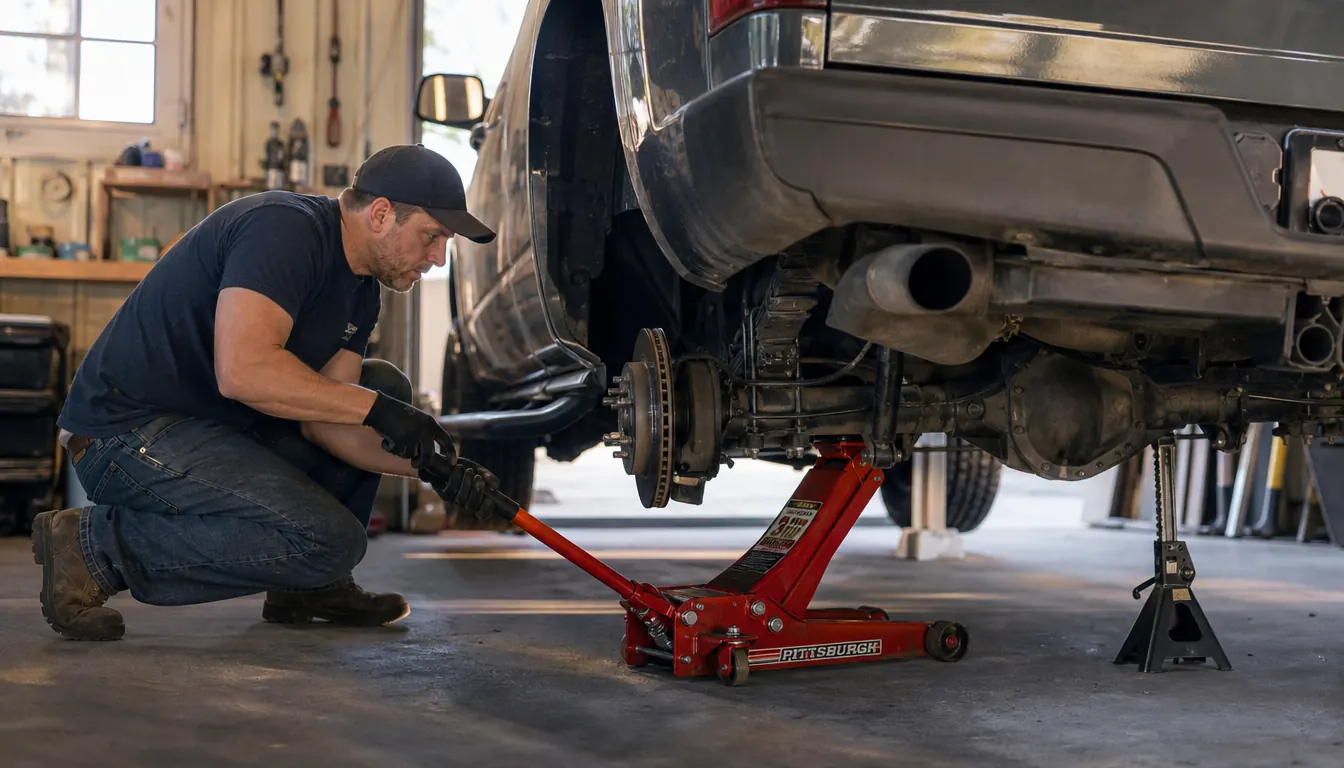
The BIG RED lifts my F-150's front end in about six full pumps. The rear end takes a few more because it is heavier, but it still goes up smoothly and without any hesitation. The hydraulic system has not leaked a drop in a year, and the release valve is smooth and predictable. I can lower the truck a fraction of an inch at a time, which is exactly what you want when you are lining up a jack stand.
The release valve deserves its own paragraph because it is the difference between a jack you trust and a jack you fight. Turn it a quarter turn and the truck comes down at a slow, even rate. Turn it a full turn and it drops fast enough to make you pay attention, but it never slams. After a year the valve still has the same feel it had on day one, with no mushiness and no creeping. That is the part of a hydraulic jack that usually goes first, and this one has not started.
The one thing I will say is that the jack does not lift as high as the product page implies. The rated lift height is around 20 inches, and I have gotten close to that, but the last inch or so is a struggle. In practice, I have never needed the full height. My jack stands are 12 inches, and the BIG RED clears them with room to spare. If you are using 18 inch stands, you might find yourself wishing for a little more.
I checked the hydraulic fluid level twice this year, once in the spring and once in the fall, and both times it was right where it should be. That is the maintenance the manual asks for, and so far that has been the whole of it. No bleeding, no topping off, no leaks on the garage floor. For a tool that gets used hard and then sits for weeks, that counts for a lot.
I have also left the jack loaded overnight once, when I had to stop a brake job halfway through. It was the rear axle, and the truck sat on the jack from about seven in the evening until eight the next morning. It held the truck up without dropping a noticeable amount. I still put jack stands under the frame before I crawl underneath, because that is the rule I have followed for thirty years, but it is nice to know the jack holds its position when you need it to.
What Nobody Tells You About the BIG RED
Here is the honest list. The handle wobbles a little. The saddle is tall, which is great for trucks and bad for low cars. The plastic wheels do not love gravel. The paint will chip if you drop a socket on it, which I have done more than once. None of these are dealbreakers, but they are the things that show up in the one star reviews, and they are all true.
The front wheels swivel and the rear wheels are fixed, which is normal for a jack in this class. On smooth concrete the jack steers nicely with one hand on the handle. The catch is that the rear wheels are narrow and hard, so they thump over the expansion joints in my garage floor, and on gravel they dig in. If your floor is smooth, you will never think about it. If it is not, budget for a little effort every time you roll the jack into position.
The other thing nobody tells you is that this jack is heavy. It weighs somewhere north of eighty pounds, and there is no graceful way to carry it. I lift it by the handle with one hand and the frame with the other, and I still grunt. If you plan to haul it to a friend's house in the truck bed, you will want a second pair of hands or a ramp. The two-piece handle helps with storage, because it breaks down short enough to lie flat in the bed of the truck or on a shelf.
The bigger thing nobody tells you is that the BIG RED is a tool you have to learn. It is not a jack that works perfectly the first time you use it. You have to learn the handle lock, you have to learn how the saddle sits on your particular lift points, and you have to learn how much room it needs. Once you learn those things, it is as reliable as any jack I have owned. But the learning curve is real, and it is the reason some people give up on it.
What I Liked
- Extra-tall saddle reaches truck and SUV lift points without a block of wood
- 6,000 pound capacity handles a half-ton pickup with plenty of margin
- Release valve is smooth and predictable, lowers the truck a fraction of an inch at a time
- No hydraulic leaks and no maintenance beyond a fluid check after a year of use
- Two-piece handle breaks down for easy storage
Where It Falls Short
- Handle collar needs a firm twist or the handle wobbles
- Tall saddle and high minimum height mean it will not fit under low cars
- Hard plastic rear wheels struggle on rough floors and gravel
- Rated lift height is optimistic by about an inch at the top
- Heavy to move around, around eighty pounds
Who This Is For
The BIG RED 3 ton floor jack is for the home DIYer who works on a truck, an SUV, or a crossover with decent ground clearance. It is for the guy who does his own oil changes and brake jobs and wants a jack that reaches the lift points without a stack of wood. It is for the weekend fixer who wants a 3 ton capacity so they never have to wonder if their jack is strong enough. If that sounds like you, this is a jack you will keep for years.
Who Should Skip It
If you drive a low sedan, a sports car, or anything with a body kit, skip the BIG RED and get a low-profile jack instead. If your garage floor is rough concrete or dirt, the plastic wheels will frustrate you. And if you are the kind of person who wants a tool to work perfectly out of the box with zero learning curve, the handle quirk will annoy you more than it should. None of that makes this a bad jack. It just makes it a jack for a specific job, and that job is lifting trucks and SUVs.
Still deciding? This is the jack I keep reaching for
A year in, the BIG RED T83006 has earned its spot under my truck. If you work on a truck or SUV, check today's price on Amazon and see if it earns a spot in your garage too.
Amazon Check Today's Price on Amazon →